Philosophy

Mantra of the Month - The Peace Chant

This mantra opens the Katha Upanishad. These are the teachings about death as taught to the most unlikely of students, a teenage boy named Nachiketa.

Om saha naa va-vatu
saha-nau bhun-ak-tu
saha veer-yum kerava-va-hay
tejas vi nava-dahee tamas-tu
ma vid-visha-va-hay.

Om shanti, shanti, shantihi.


Om.
May we be protected
May we enjoy each other
May we work together vigorously
May our study be illuminating
May we not quarrel.
Om, peace, peace, peace.

Om Saha na vavatu

Spiritual Materialism or Beware of the Shiny Object

In the interview with Brene Brown that I just shared, she cautions us to beware of the shiny object.  This is a common warning in yoga, and perhaps in life as well.  In the Bhagavad Gita, Krishna gives Arjuna the same warning:

You have a right to your actions, but not your actions fruits.  Act for the action’s sake.”  B.G. II.47

In the Yoga Sutra of Patanjali, the third chapter is devoted to the powers or siddhis that one can acquire through the practices of yoga.  Patanjali is not merely referring to asana.  He very clearly spells out that these yogic practices are specifically related to the last three rungs on the ladder of yoga; namely dharana (concentration), dhyana (meditation) and Samadhi (absorption).

In his commentary on the Yoga Sutras, Mr. Iyengar says this:

“On this innermost quest, supernatural powers or accomplishments (vibhutis) come naturally to a yogi who has integrated his mind, body and soul.  There is a danger that he will be seduced by these powers.  He should bypass them in order to pursue his practice as far as kaivalya, the height of indivisible existence.”

The essence of what he is saying is that when we strive wholeheartedly towards a goal, gratifying rewards and results will incidentally come our way.  It is easy to become enamored of what we have accidentally acquired and that we mistake it for the goal itself.

He gives three examples of how the lure of the shiny object can ensnare us.

The first is that of a young person who dreams of becoming a great actor.  On the way he acquires fame, and if he does not have his priorities straight, he makes fame his new goal.  This power, or siddhi, can enchant him, swallow him up and spit him out.

The second example is that of a young business man who sets out on his career to provide for his family.   Along the way he becomes rich. He now has more than enough, but riches and their pursuit now possess him.  He neglects his wife and children who live in sterile luxury while he pursues money and more money for its own sake.

The third example is that of a man who, through the merits of past lives, is born into a royal household.  Instead of regarding his good fortune as a sign that he must humbly serve his people, he becomes seized by pride of birth and behaves tyrannically.

In all of these examples, the protagonist has let himself be side-tracked, has substituted an agreeable and merited by-product of his efforts for the real goal.  At best his progress is stopped, at worst he is consumed; and in all cases illusion has displaced reality.  The lesson of the siddhis for all of us is not to allow ourselves to be side-tracked, but to stay the course.  Someone who has let themselves become ensnared by the glamour of the siddhis is like one who believes that the bricks and mortar of the temple are God him/herself.  This is known as spiritual materialism.

In the blog post I wrote about Krishna Das and his song Sri Argala Stotram, he talks how about the trap he fell into.  When he lived in India on an ashram he had few possessions, he didn’t need many things to survive.  When he came back to the States, he felt superior to people who he thought were too attached to their possessions.  As he matured, he realized that you need a rich inner and outer life.   It is okay to be comfortable.  Having possessions or not having possessions is a way of life.  One is not superior to the other.

And so it goes with our physical practice as well.  Asana is just one of the eight limbs of yoga.  Being physically strong and flexible is nice and may make us more comfortable in our bodies.  But being able to put your foot behind your head does not mean you are more enlightened than the next person. In my yoga practice I have noticed that whenever the pose became the thing I was seeking, I usually had a lesson delivered to me in the way of an injury.  Instead, when I focus on the practice for the sake of doing the work with mind, body and breath intertwined, that is when the magic happens.

Mantra - Hridaye Citta Samvritta

This mantra comes from the Yoga Sutras, Book 2, verse 35

Hridaye means on the heart

Citta is consciousness

Samvritta means knowledge, awareness

By focusing and holding concentration on the region of the heart, the yogi acquires a thorough knowledge of the contents and tendencies of consciousness.

“The citadel of purusha (consciousness) is the heart.  It is the anahata chakra (heart chakra) the seat of pure knowledge as well as consciousness.  By focusing and holding concentration there a yogi can become aware of consciousness and of true, pure knowledge.  He learns to unfold and tap the source of his being, and identify himself with the Supreme.”  - from Light on the Yoga Sutras of Patanjali by B.K.S. Iyengar.

I hope you enjoy watching this video.  It comes from the Iyengar yoga conference of 2016 in Boca Raton, Florida.  It features 3 of the top Iyengar yoga teachers in the US.  Their devotion in performing a series of back bends is very inspirational!  Near the end of the video, at 15:25, they do this chant.

Om Mani Padme Hum

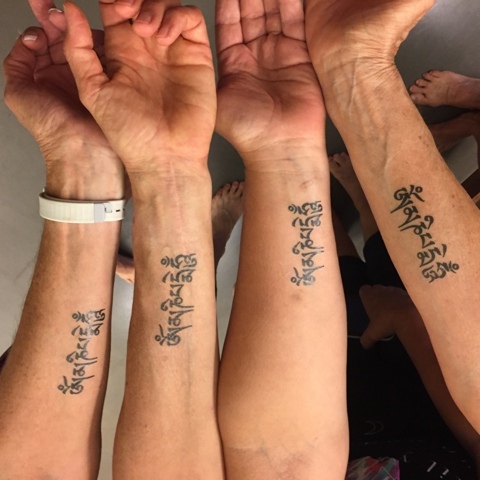
Om Mani Padme Hum as Temporary Tattoos

Om Mani Padme Hum as Temporary Tattoos

My friend and yoga student, Dan Telep died on August 5th, 2014, a few days before his 80th birthday. He went out for a bike ride and that day and never came back. He died doing one of the things he loved doing. He said his doctor told him that if he was still riding his bike at the age of 80, the odds were that he would probably die on his bike. I’m sorry to have lost Dan, but I am glad that he went out the way he did, full of life and adventure.

The mantra I have chosen for the month of August is in memory of my friend. Dan told me that he chanted “Om Mani Padme Hum” while riding his bike. It helped him push the pedals and get up hills. It was Dan that inspired me to ride the MS City to Shore Bike Ride. I had always wanted to do it, but I always found an excuse to not do it: “It’s too far. What if I can’t do it? What if it rains, or is cold, or, ….” Losing Dan motivated me to stop procrastinating and get going!

This chant is often called “The Jewel in the Lotus” because the mantra is said to contain the essence of the teaching of the Buddha which is that life is filled with suffering. Once we really learn that suffering exists, we can look deeper and discover its cause. When we discover that the cause is dependent on certain conditions, we can explore the idea of removing those conditions. This is the process of becoming enlightened; to understand what we need to do in order to save ourselves and others from suffering.While this mantra has no direct translation, its six syllables are said to represent The Six Paramitas of the Bodhisattvas, or The Six Perfections. These are six lessons we need to learn to overcome suffering:

The first syllable, Om, is supposed to bless you and help you achieve perfection in the practice of generosity. Ma helps perfect the practice of ethical behavior. Ni helps achieve perfection in the practice of tolerance and patience. Pad helps to achieve the perfection of perseverance. Me helps achieve perfection in the practice of concentration and the last syllable, Hum, helps achieve perfection in the practice of wisdom.

Chanting this mantra with dedication and devotion can transform your impure body, speech and mind into the pure body, speech and mind of a Buddha.

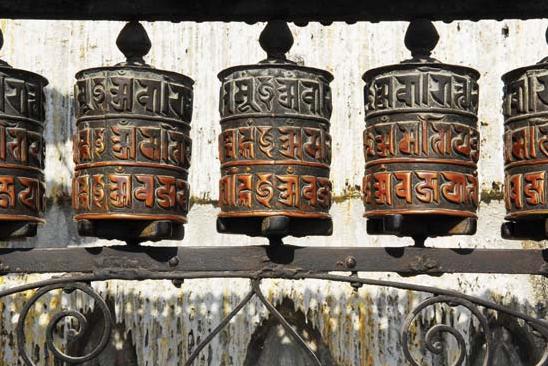
Om Mani Padme Hum is often the mantra depicted on Buddhist prayer wheels.

prayer-wheels.jpg

P.S.  People have been asking me for links to the mantras I have been playing in class.  Here they are:

The first one is the version by M.C. Yogi called Prayer Wheel.

The second one is Secret Sounds by Veet Vichara and Premanjali

Lokah Samastah Sukhino Bhavantu

“May all the beings everywhere be happy and free and may the thoughts, words and actions of my own life contribute in some way to that happiness and to that freedom of all.”

By chanting this mantra, we move from our personal self and radiate a prayer of love for the world around us. It takes us from the egoic, little self, and its limited world view, and radiates from us global wellbeing. It is a reminder we are a part of the universe and can positively impact all of creation.

Though not a traditional Vedic mantra, Lokah Samastah Sukhino Bhavantu is a Sanskrit prayer (or sloka). It has been used for many centuries to invoke greater states of compassion and peace. Often said at the end of yoga practices, it is an invocation for personal and collective peace. “Do unto others as you would have them do unto you” may be the closest western equivalent. Yet, the impact of this ancient mantra is far grander than simple human kindness.

Guru Jagat teaches “To vibrate these sounds within the body, we raise the frequency of our beingness.” We say these words not only for personal power but that they may raise our vibration. Once we achieve this elevated state, the mantra radiates from us to bless others. In this way we better affect the collective states of love on the planet.

Propasana

Props – devices used to help students align their yoga poses.

Propasana – the practice of putting all props away,  neatly folding the blankets and winding up the straps.

While walking down the street in Manhattan one day, my friend bends down to pick up a piece of trash and throws it out in the nearby trash can.  This is something I have done before, but I was surprised to see a native New Yorker doing it.  When I asked him about it, he said that there was an anti-littering campaign that advertised if every one of New York’s 8.5 million people would pick up just one piece of trash a day, there wouldn’t be any litter on the streets of New York City.  He thought it made sense and was doing his part.  What would the world be like if we all cleaned up after ourselves?

This is part of the idea of saucha, or cleanliness, the first of the Niyamas, or practices for the self, outlined in the Yoga Sutras.  Cleanliness can be interpreted on several levels.  There is the cleanliness of the body to promote health.  It is recommended that you eat a clean diet, with lots of whole and fresh foods.  Eating well promotes health and mental clarity.  Junk foods and intoxicants can cloud the mind.  Cleanliness can also refer to the thoughts.  We are more settled when our thoughts are not disrupted by disturbing emotions such as greed, envy, anger, pride, hatred, lust and delusion. Then there is the cleanliness of our bodies and our physical surroundings.

In How Yoga Works, Miss Friday tells the Captain that yoga works on the outside and the inside.  We do poses, breath work and meditation to knock on the pipes from the inside, but we also must knock on the pipes from the outside.  She explains it like this:  “And there’s this constant interchange going on, you see; this constant interplay of the forces outside and inside of you.  You get frantic at work often enough, and it ties up the inner channels.  That causes an injury like your back; actually just a reflection of something going on deeper, in the channels.  That makes you grumpier, which tightens the choke-points even more, and then because you don’t feel well you’re not as careful about things in general.  And one of those things is just simple neatness: tidiness.  A lack of this very basic kind of cleanliness – plain old tidiness – is almost a sure sign that your channels are ‘untidy’ too, deep down inside: the thought winds are jumbled up, ready to turn into a new choke-point at any time.”

“And so a very simple and effective way to take advantage of the interchange, the interplay, between outside and inside is just to . . .” I waved my arms around again “. . . clean the place up!  If where you live; if where you work; and especially if the place where you do your yoga poses is clean and tidy, then this is all reflected back upon the inner winds, . . .”  I paused.

“And the channels loosen up, and the poses work even better on fixing you; on keeping you strong and healthy,” finished the Captain.

“And you see, something else is at work here too.  If there’s less junk around the room, then when you go to focus and fix your mind on a single point, then there are not as many things that the mind has to sift through to get at what you want to focus on.  It’s a lot easier to find a friend in a group of ten people, especially if they are all lined up , than in a crowd of a hundred all milling around.  It takes less effort, much less effort to focus – all day long.  Focus is like food for the mind: the mind thrives on it, and so do the good inner winds.”

“And once you are done with your room, “I said, “You can go further.  I mean don’t just tidy things up – throw out absolutely as many things as you can.  Half the things that fill up our houses at any given moment are things that we don’t even use anymore, at all.  And a good part of the other half are things that we rarely use, or don’t really need to use anyway.

“And these extra things in our house, you see, they’re tricky.  I mean, it looks like they are just sitting there , pretty harmless, and that’s why we let them stay there.”

“But if I say right now, ‘Think of some of the things in your house’ . . . I paused again so he could do it – and he got sort of an odd look on his face.  “Then you can remember a great many things lying around your house, whether you ever use them or not.  And that proves, you see, that they were taking up a part of your mind: you can remember them, because information about each one of them is stored in your mind.  And the mind – although we don’t often think of it this way – has only so much capacity.  Every time you acquire another object – every time there’s one more thing cluttering up your home – then there’s one more thing cluttering up your mind as well.  And as the mind goes, so do the inner winds, and the choke points in the channels.”

“What you are saying, then,” observed the Captain, “is that the more unused, use-less things I have lying around, the worse it is for my back, and even my peace of mind, because it hurts my channels.”

“Just so,” I said with a smile.  “And when you’re done clearing out the extra things around your house, then you have to go on to your very way of life and do the same.  Throw out extra things you do that you really don’t have time to do well, so you can focus.  Throw out extra things you say that don’t really need to be said anyway; learn to be with your friends, a few good friends, in a happy sort of silence that you both understand and appreciate.  Cut down on all the extra, useless outside stimulation of your physical senses: too much food, too much news, too much ‘entertainment’, too much physical gratification with the opposite sex; all of them fine in themselves, all of them healthy, but in moderation: in amounts that you can focus on and enjoy deeply.”

“And the mind will be free to come inside, and arrive at its own nature: concentration, contemplation, uninterrupted attention – medicine for the channels, medicine for the inner winds, and so for health and a happy state of mind that lasts.  It’s all a kind of cleanliness, in a way:  tidiness on the outside, tidiness on the inside.”

Take a look at these two pictures:

prop-closet-messy-web-large.jpg
prop-closet-full-neat-web-large.jpg

How does each one affect you?  Your mind?  You can leave a comment below and let me know what you think.

Does the fact that your house, office or car is a little cluttered have much to do with my yoga?  Master Patanjali seems to think so because the first Niyama, or self practice is cleanliness.  Y.S. II.32

Mantra for the Month of June

Om, Asatoma Sat Gamaya
Tamaso Ma Jyotir Gamaya
Mrityor Ma Amritam Gamaya


Lead me from the unreal to the real
from darkness (ignorance) to light (knowledge)
and from death to immortality

One of the first Kleshas, or obstacles on the path of yoga is avidya which means not seeing things clearly.  This is a great mantra to chant when you are stuck.  Often we are stuck when we can't see the thing right in front of us.  Chanting this mantra will help clear the mind.  Once the mind is clear, the path is often revealed.

Try chanting this mantra for 21 days to gain the wisdom of clear sight.

How is Progress on the Path Measured?

Gratitude-journal-web-large-4x6-landscape.jpg

In one of the yoga teacher training programs I took, I had a manual that had an interesting index heading:  "Measuring the Efficacy of Practice".   I turned eagerly to the page to read what it said.

“Progress on the path of yoga is defined by an increase in happiness and contentment; your relationships improve, your feathers get ruffled less easily and you can find contentment in any moment, even if it is painful.” ( I paraphrased, it was actually quite a bit longer, but that is the gist of it.)

The goal of any authentic spiritual practice is to stop suffering and attain perfect happiness.  We are hardwired to seek pleasure and avoid pain.  But, most people seem to be living in a state of vague discontent.  How do we become happy?  The first step is to look around us and see how unbelievably lucky we really are.  Count your blessings.  Focus on all that you do have.

In order for this to be effective it is necessary to establish the practice of gratitude.  Once a day stop and take stock of 5 things you have to be grateful for.  You can keep a journal if you like a writing practice, or you can simply pause during the day and think of these things.

There is a well known saying:  It is not happiness that makes us grateful, but gratitude that makes us happy.

The next step is to go on a complaining fast.  If you don’t like something and you can change it, then do so.  If you can’t, complaining won’t help.

You may be surprised at how much of what passes for conversation is actually complaining.  Once you become aware of this habit you may notice when others are complaining.  In that case, don’t judge, simply take note and turn the mirror on yourself.  Is that what you look and sound like when you are complaining?   Does complaining help you get happier?  According to the laws of karma, complaining only brings about more of the same.

One interesting note is that there has been less complaining in class.  There are no good poses or bad poses unless we assign them such qualities.  Challenging yoga poses are the perfect opportunity to practice breathing with equanimity under pressure.

Try these three practices: Count your blessings, keep a gratitude journal and go on a complaining fast and let me know how you are making out.  Share your thoughts by leaving a comment in the space below.

Namaste,

Karin


P.S.

I wanted to share a poem I heard on my favorite podcast "On Being"  with Krista Tippet. It seemed to fit with the theme of gratitude.

“I had no idea that the gate I would step through / to finally enter this world / would be the space my brother’s body made. He was / a little taller than me: a young man / but grown, himself by then, / done at twenty-eight, having folded every sheet, / rinsed every glass he would ever rinse under the cold / and running water. / This is what you have been waiting for, he used to say to me. / And I’d say, What? / And he’d say, This — holding up my cheese and mustard sandwich. / And I’d say, What? / And he’d say, This, sort of looking around.”  - Marie Howe

The Heart Sutra Mantra

Heart Sutra Mantra

The mantra for the month of May is the Heart Sutra Mantra:

Gate gate paragate parasamgate bodhi svaha!

Gate means gone. Gone from suffering to the liberation of suffering. Gone from forgetfulness to mindfulness. Gone from duality into non-duality.
Gate gate means gone, gone.
Paragate means gone all the way to the other shore.
Parasamgate sam means everyone, the entire community of beings. Everyone gone over to the other shore.
Bodhi is the light inside, enlightenment, or awakening. You see it and the vision of reality liberates you.
Svaha is a cry of joy or excitement, like "Welcome!" or "Hallelujah!"

"Gone, gone, gone all the way over, everyone gone to the other shore, enlightenment, Hallelujah!"

What Sangharakshita says about the Diamond Sutra equally applies to all Prajnaparamita Sutras, including the Heart Sutra:

…if we insist that the requirements of the logical mind be satisfied, we are missing the point. What the Diamond Sutra is actually delivering is not a systematic treatise, but a series of sledgehammer blows, attacking from this side and that, to try and break through our fundamental delusion. It is not going to make things easy for the logical mind by putting things in a logical form. This sutra is going to be confusing, irritating, annoying, and unsatisfying—and perhaps we cannot ask for it to be otherwise. If it were all set forth neatly and clearly, leaving no loose ends, we might be in danger of thinking we had grasped the Perfection of Wisdom.—Sangharakshita, Wisdom Beyond Words

A Rama Healing Mantra

“Om apadamapa hataram dataram sarva sampadam lokah bhi ramam shri ramam bhuyo bhuyo namam yaham”

Om apadamapa
mala-thumbnail.jpg

This is one of my favorite mantras.  It is a little bit of a mouthful, but once committed to memory, it is fun to chant.   Repeating this mantra always makes me smile, which is part of its healing properties; joy and happiness are healing emotions.

This is considered a Rama mantra: “bhi ramam shri ramam”.  Rama has a threefold meaning here.  First, Ram is the seed sound of the manipura, the third or solar plexus, chakra.  Here lies the power of your internal sun and life force.  The third chakra is associated with energy, will and mastery.  The body parts governed by the third chakra are the mid-torso, the side bodies, ribs, adrenal glands, belly and digestive organs.  When your third chakra is strong and balanced you radiate warmth, dexterity, skill and mastery.  When your third chakra is deficient you may feel controlling, dominating and be constantly active.  You may feel weak, passive and tired.  Chanting this mantra with the intention of healing can balance your third chakra.

Manipura, the third chakra

Manipura, the third chakra

The second meaning comes from dividing Rama into its syllables: Ra and Ma.  Ra is associated with the solar current that runs down the right side of our body and Ma is associated with the lunar current that runs down the left side of our body.  These currents crisscross in our bodies.  Scholars say that it is this criss crossing action that spins our chakras.  Chanting this mantra can balance these energies and our chakras.

The third reference is to the god Rama himself.  Rama is a kind, benevolent healing energy.  You can read about Rama in a text called the Ramayana, which means Ram’s way.  It is a wonderful story filled with many lessons taught through intriguing twists and turns.

A typical mantra practice involves chanting a mantra 108 times, at least once a day for 30 or 40 days.    Once you learn this mantra, it will take you about 30 minutes (give or take) to chant it 108 times.  You can use a mala to help you chant it.  But you also do a practice of 108 times without a mala.  Time yourself chanting the mantra. Once you know how long it takes, you can simply use your timer.  There is also a way to make a mala using your hands.  You count the “segments” of each finger.  There are three segments on each finger, twelve on one hand.  Every time you go through all twelve segments on one hand, you count one segment on your other hand.  When you get to nine segments on the second hand you have reached 108 (9 x 12 = 108).  While there is something soothing about clicking through the beads of a mala, there are times when I want to chant and I don’t have my mala with me. It is very helpful to have different ways to maintain your practice.

Let me know if this mantra has helped you.