Philosophy

Education and The Spiritual Journey

“Yoga does not just change the way we see things, it transform the person who sees.” B.K.S. Iyengar

I recently listened to (and thought you might enjoy) Terry Gross’ interview with Barbara Brown Taylor on Fresh Air this past week. Ms. Taylor is an ordained Episcopal priest who left her job as rector of a church to become a professor of religion. Barbara Taylor has written several books on religion and spirituality including: An Altar In the World, Learning to Walk in the Dark, Leaving Church and her memoir titled Holy Envy.

As a professor of religion, Taylor said that she “hoped it would be a way to convince {the students} that they could find things they liked about other traditions, and it would not make them disloyal to their own.” She said that it worked most of the time.

Taylor writes about how teaching the different religions changed her student’s understanding of faith, as well as her own. She was asked if she was concerned about shaking the faith of her students. She answered: I think that education does that – whatever the subject matter. So, yes, I did feel as if in the field of religion I was in the business of making misfits, who would never quite fit the same way in their faith communities, their families. Then I started talking to colleagues in other fields and they said, “Yeah, that’s what we do at college, it’s that people grow and change and don’t fit where they used to.’”

Education does that – whatever the subject matter – and yoga is just a different subject.

In Zen Buddhism, this process of education, or moving towards enlightenment is represented by the 10 Bull Pictures.

In psychology, a similar learning curve is depicted by The Four Stages of Competence.

In the beginning we are Consciously Incompetent. This is the ignorance is bliss stage. We don’t know what we don’t know. The second stage is Conscious Incompetence. We know our arms are bent, but we aren’t able to straighten them. This can be a little frustrating. Then there might be a breakthrough and if we really concentrate, we can straighten our arms. This stage is called Conscious Competence. Finally through perfect practice we may enter into the state of Unconscious Competence where we don’t have to think about it, we know our arms are straight.

Another book you might enjoy in this same vein is Educated by Tara Westover. Ms. Westover wasn’t your garden variety college student. When the Holocaust was mentioned in a history class, she didn’t know what it was (no, really). That’s because she didn’t see the inside of a classroom until the age of seventeen. Public education was one of the many things her religious fanatic father was dubious of, believing it a means for the government to brainwash its gullible citizens, and her mother wasn’t diligent on the homeschooling front. If it wasn’t for a brother who managed to extricate himself from their isolated—and often dangerous--world, Westover might still be in rural Idaho, trying to survive her survivalist upbringing. It’s a miraculous story she tells in her memoir Educated. For those of us who took our educations for granted, who occasionally fell asleep in large lecture halls (and inconveniently small ones), it’s hard to grasp the level of grit—not to mention intellect—required to pull off what Westover did. But eventually earning a PhD from Cambridge University may have been the easy part, at least compared to what she had to sacrifice to attain it. The courage it took to make that sacrifice was the truest indicator of how far she’d come, and how much she’d learned. Educated is an inspiring reminder that knowledge is, indeed, power. --Erin Kodicek, Amazon Book
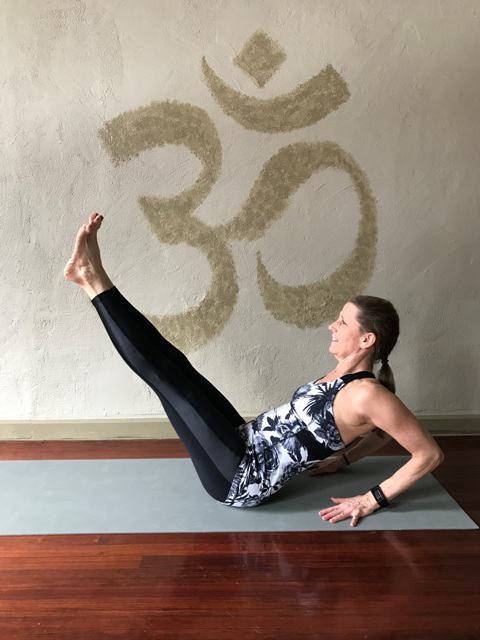
Can't Do Boat Pose?

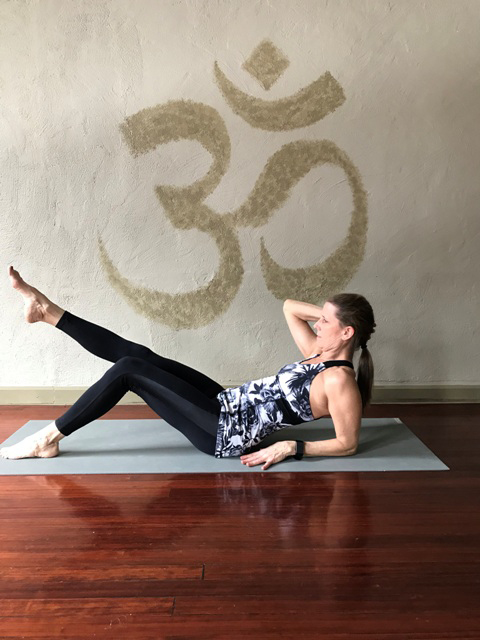
Modifications for Navasana

In the book How Yoga Works, Miss Friday notices that the Captain skips doing Boat Pose in his practice.  When she asks him about it he says the pose is not for him because it hurts his back.  She lets him know that he needs to do all of the poses that she taught him and that each pose has its benefits.  Leaving out the poses we don’t like simply reinforces our imbalances and the duality that our preferences create.  Often the poses we most want to avoid because we can’t do them or they are uncomfortable are the very ones we need to do.

She quotes from Patanjali's Yoga Sutras to him: And then there will come a time when differences (attachment and aversion) no longer disturb you.  Y.S. II.48

However, we shouldn’t just push through pain to do a pose.  It is possible to find a manageable variation for everybody in any pose.

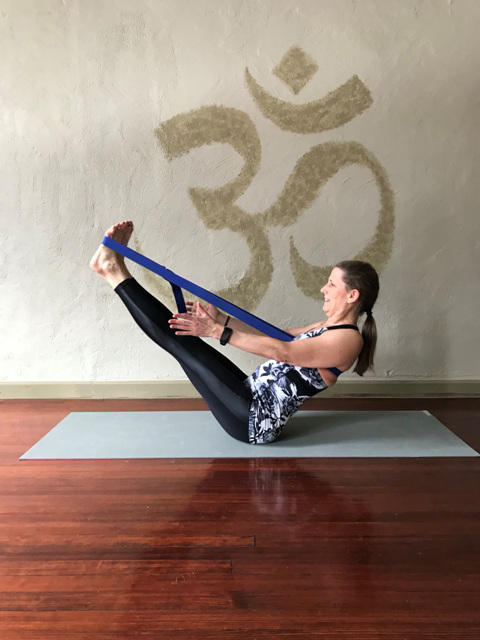
If you find Navasana to be a challenging pose to do, here are a couple of good variations that you can practice.

Full Boat using the arms for support

Full Boat using the arms for support

Full Boat with bent knees and hands on (or off of) the floor

Full Boat with bent knees and hands on (or off of) the floor

Half Boat, one foot on the floor and using one arm for support

Half Boat, one foot on the floor and using one arm for support

Full Boat using a belt for support

Full Boat using a belt for support

Try any one of these variations, or even combinations of the variations that I haven't pictured, and see if you can make any improvements in your Boat Pose.  Feel free to play and find something you can do!

“So no more faces when you come into a pose that’s hard for you.  The hard ones are usually doing you and your back the most good.  Don’t give in to preferences; don’t create more differences in your life.  It’s the differences that harass us all day long that make our days unhappy.  I like this, I don’t like that.  I like her, I don’t like him.  I don’t want to do this thing I have to do, I’d rather do that thing I want to do.”  (I’m tired of this cold weather and snow already, I’d like it to be 30 degrees warmer!)  Miss Friday to the Captain in How Yoga Works.  (Except the part about the weather,  that’s me!)

Chanting the Sanskrit Alphabet

Chanting the Sanskrit Alphabet

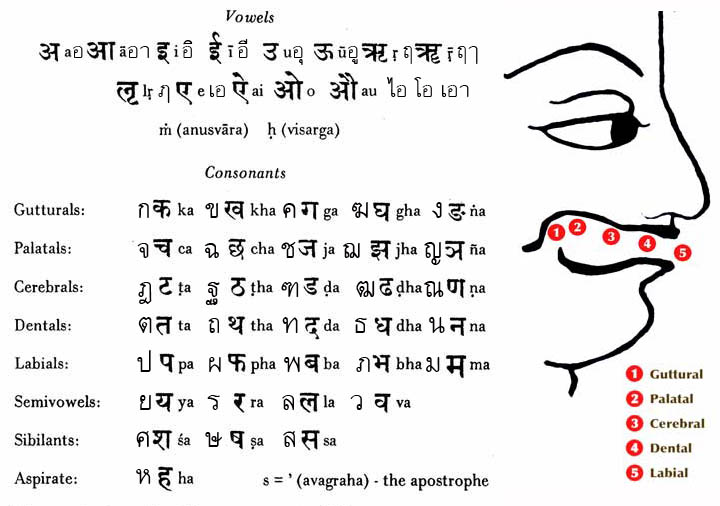
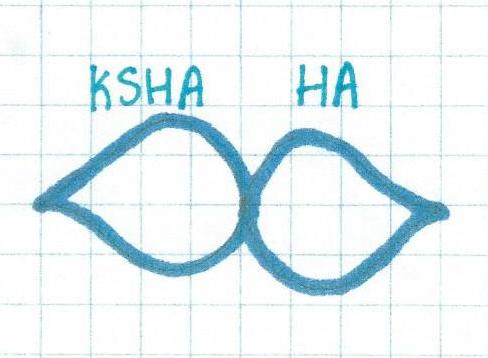
This month we will be learning the Sanskrit alphabet. Chanting the Sanskrit Alphabet is much more than learning the letters and the sounds. Each letter represents a petal in one of our chakras. Chanting the alphabet can open our chakras.

We start by chanting the vowels and then move through the consonants.  The consonants are grouped by how they are pronounced.  The gutturals are created in the back of the throat.  The palatals are created in the upprer palate.  The cerebrals are created by curling the tongue back and touching the tip of it to the roof of the mouth.  The dentals are created with the tongue touching the teeth and the labials are created with the lips.

sanskrit-chart.jpg

Listen to Nicolai Bachman, who wrote The Language of Yoga,  chant the alphabet here:

Sanskrit Alphabet
Nicolai Bachman

Each letter stimulates a petal in one of the chakras:

The throat chakra

The throat chakra

The heart chakra

The heart chakra

The solar chakra

The solar chakra

The pelvic chakra

The pelvic chakra

The root chakra

The root chakra

The third eye

The third eye

Mantra of the Month for February - Guru Mantra

Guru Mantra

Guru Brahma Guru Vishnu Guru Devo Maheshwaraha
Guru Saakshaat Para Brahma Tasmai Sri Gurave Namaha

Guru is the Creator (Brahma), Guru is the Preserver(Vishnu), Guru Deva is Destroyer(Maheshwara). Guru is the absolute (singular) Lord himself, Salutations to that Sri Guru

Translation word by word:

  • Guru: Dispeller of Darkness; Gu=Darkness, Ru=Remover

  • Brahma: Creator; Personification of Creating Quality of God

  • Vishnu: Preserver; Personification of Preserving quality of God

  • Deva: God

  • Maheshwara: Destroyer; Personification of Destroying Quality of God

  • Saakshaat: Self/ Himself

  • ParaBrahma: He who is the highest Lord; Consciousness

  • Tasmai: To him/ To such

  • Sri: Holy, splendorous

  • Namaha: Salutations

Here is my favorite rendition of this mantra being chanted by Bhagavan Das.

This is Purna, That is Purna.

ॐ पूर्णमदः पूर्णमिदं पूर्णात्पुर्णमुदच्यते
पूर्णस्य पूर्णमादाय पूर्णमेवावशिष्यते ॥
ॐ शान्तिः शान्तिः शान्तिः ॥

Om poornamadah poornamidam Poornaat poornamudachyate Poornasya poornamaadaya Poornamevaa vashishyate.
Om Shaantih Shaantih Shaantih

(Listen to the Ravi Shankar version here.)

Meaning:
Om, That (Outer World) is Purna (Full with Divine Consciousness); This (Inner World) is also Purna (Full with Divine Consciousness); From Purna comes Purna (From the Fullness of Divine Consciousness the World is manifested) ,
Taking Purna from Purna, Purna Indeed Remains (Because Divine Consciousness is Non-Dual and Infinite).
Om Peace, Peace, Peace.

We are made from Divine Consciousness. We are made from the same stuff as the stars and planets. In yogic tantric literature, the Divine so wanted to experience itself in every possible incarnation that it manifested as you and me and everything else in our material world. This descent of how the “One” becomes the many is described as the 36 Tattvas. These describe the principles of existence and of consciousness becomes matter. Basically, it describes how we came to be.

It is one thing to learn about us all “being one”. It is quite another thing to experience it. We all have moments in our lives where we feel that we are connected; that we have the insight into a deeper part of ourselves and we perceive that oneness. More often, though, we feel separate and different. This experience of differentiation comes from a power called Maya, or illusion. Maya has three ways in which it operates; the three Malas. They are:

1. Anava Mala
Creating feelings of unworthiness, the source of incompleteness we experience. It gives rise to feelings of insecurity and sadness. Connected to the heart.

2. Mayiya Mala
Perception of difference, separateness between us and the world. Creates comparison to others. It gives rise to feelings of jealousy and anger. Connected to the mind.

3. Karma Mala
The capacity for limited activity, the feeling of inability to act, not doing enough. It gives rise to feelings of worry and fear. Connected to the body.

These Malas are part of our existence, part of the fabric of who we are. As such, there is no need to get upset about it or even trying to “rid” ourselves from these perceptions. Yoga can teach us to become observant when these Malas come up. We cultivate the power of discernment to help us see that even though we feel a certain way, it is not who we are. With this increased awareness, we work with the Malas and not against them and we will be able to see ourselves as we truly are: Pure Consciousness.

This mantra is meant to help us connect to that sense of “Oneness”.

Here is another beautiful recording of the mantra for your listening pleasure!


This reading from Louise Hay seems to go perfectly with this mantra:

In the infinity of life where I am, all is perfect,
whole and complete and yet life is ever changing.
 There is no beginning and no end,
only a constant cycling and recycling
of substance and experiences.
Life is never stuck or static or stale,
for each moment is  ever new and fresh.
I am one with the very Power that created me and this Power
has given me the power to create my own circumstances.
I rejoice in the knowledge that I have the power
of my own mind to use in any way I choose.
Every moment of life is a new beginning point
as we move from the old.  This moment is a new point
of beginning for me right here and right now.
All is well with my world.

from You can Heal Your Life by Louise L. Hay.  You can download a pdf version of the book here.

Chanting AUM

AUM: The Best Praise or Prayer

The Latin word Omne and the Sanskrit word Aum are both derived from the same root meaning all and both words convey the concept of omniscience, omnipresence and omnipotence. Another word for Aum is pranava , which is derived from the root nu meaning to praise, to which is added the prefix pra, denoting superiority. The word, therefore, means the best praise or the best prayer.

The symbol Aum is comprised of three syllables, namely the letters A, U, M and when written has a crescent and dot on its top. A few instances of the various interpretations given to it may be mentioned here to convey its meaning.

The letter A represents the deepest sound in the body that can be made. It is a sound that comes from the throat. The U represents the sound in the middle of the palate. The M represents the sound at the furthest extent that the human voice can create, at the end of the lips. Thus A, U, M represents the sounds of creation represented by the power of speech. As it says in Genesis: In the beginning was the Word and the Word was God. Aum represents the power to create through speech.

The letter A symbolizes the conscious or waking state, the letter U the dream state, and the letter M the dreamless sleep state of the mind and spirit. The entire symbol, together with the crescent and the dot, stands for the fourth state, which combines all of these states and transcends them. This is the state of Samadhi (a state in which the aspirant is one with the object of his meditation, the Supreme Spirit pervading the universe, where there is a feeling of unutterable joy and peace).

The letters A, U, M symbolize respectively speech, the mind and the breath of life, while the entire symbol stands for the living spirit, which is but a portion of the divine spirit.

The three letters also represent the dimensions of length, breadth and depth, while the entire symbol represents Divinity, which is beyond the limitation of shape and form.

The three letters A, U and M, symbolize the absence of desire, fear and anger, while the whole symbol stands for the perfect man, one whose wisdom is perfectly established in the divine.

They represent the three genders, masculine, feminine and neuter, while the entire symbol represents all creation together with the Creator.
They stand for the three gunas or qualities of sattva, rajas and tamas, while the whole symbol represents a gunatita, one who has transcended and gone beyond the pull of the gunas.

The three letters correspond to the three tenses – past, present and future – while the entire symbol stands for the Creator, who transcends the limitations of time.

They also stand for the teaching imparted by the mother, father and Guru respectively. The entire symbol represents Brahma Vidya, the knowledge of the Self, the teaching of which is imperishable.

The three letters depict the three stages of yoga discipline: asana, pranayama and pratyhara, The entre symbol represents Samadhi the goal for which the three stages are the steps.

They represent the triad of Divinity, namely Brahma the creator, Vishnu the maintainer and Shiva the destroyer of the universe. The whole symbol is said to represent Brahman from which the universe emanates, has its growth and fruition and into which it emerges in the end. It does not grow or change. Many change and pass, but Brahman is the One that remains unchanged.

The letters A, U, M also stand for the mantra “Tat Twam Asi” (That Thou Art), the realization of man’s divinity within himself. The entire symbol stands for this realization, which liberates the human spirit from the confines of his body, mind, intellect and ego.

After realizing the importance of AUM, the yogi focuses his attention on his beloved Deity adding AUM to the name of the Lord. The word Aum being too vast and abstract, he unifies his senses, will, intellect, mind and reason by focusing on the name of the Lord and adding the word AUm with one-pointed devotion and so experiences the feeling and meaning of the mantra.

The yogi recalls the verses of the Mandukopanisad: Taking as a bow the great weapon of the Upanisad, one should put upon it an arrow sharpened by meditation. Stretching it with a though directed to the essence of That, penetrate the Imperishable as the mark, my friend. The mystic symbol AUM is the bow. The arrow is the self. Brahman is the target. By the undistracted man is It penetrated. One should come to be in It, as the arrow in the mark.

Most of this is taken from Light on Yoga by B.K.S. Iyengar

Doing it Right

Doing It RIght

In the book, “How Yoga Works,” Miss Friday is working with her student, the Captain.  The Captain comes to yoga as a lot of us do, to help us get out of pain; in this case back pain. He has been working with his teacher for a little while and he is pleased with the progress he is making.  But, as he practices Miss Friday sees that he is cheating in Pascimottanasana (Seated Forward Bend).  He is feeling a little pride in his practice because he can already touch his head to his knees in this seated forward bend.  But Miss Friday stops him.  He doesn’t understand why she stops him. But she tells him that he is cheating because he is bending his knees and rounding his spine in order to get his head to touch his head to his knees. (a common cheat)  She warns him that his both his back and legs are supposed to be straight.  She describes the correct bio-mechanics of hinging from the hips and not folding at the waist.  She tells him that they are doing the practice to make his back healthy again, not to make sure that he can touch his head to his knees.

Y.S. I.14  Your practice must be done correctly, for then a firm foundation is laid.

Miss Friday tells the Captain: “You see, the point is not what the pose looks like in the end.  It’s the process of the pose as it goes on; it’s what it does inside of you, how it works to begin to straighten and open your channels.   These are the channels of how energy flows in the body.  (More about that in another post!) Miss Friday goes on to say:  “But if you don’t do the pose right, if you cheat, if you try to trick the pose and get around it just so you look good, then the pose doesn’t work on you the way it is supposed to.”

She asks him to do the pose, again, without bending his knees, which he does.  It’s a beautiful pose, his back is straight, his legs are straight and he is hinging at the hips.  But the Captain is unhappy because his head is about 2 feet from his knees!

Pascimottanasana-do-and-dont.png

We are often like the Captain, impatient in our progress and mistaking what it not important for what is important.  Often a student sees someone do a very advanced Pascimottanasana and sees that their head is touching their legs, so they think that is important, but what they don’t see is the straightness of the legs and the long, almost straight line of the back.  It can take a long time to get to that stage of practice with a lot of hard work and true understanding of what is going on in the body.

Pascimottanasana-4-x-6.jpg

One of the things I love about the study of yoga and the stories and mythologies that it uses to teach us is that we are meant to see ourselves in every character of the story.  Can you see yourself as the Captain?  Can you see yourself as Miss Friday?  Sometimes it is hard for us to recognize ourselves as the Captain, especially if we don’t like what we see.  But, we are also meant to see ourselves from a different perspective.  That way we can see if we are cheating ourselves and examine why.  Pride?  Envy?  Impatience?  While Impatience is not one of the Seven Deadly Sins from Christianity, or the Six Enemies of the Heart from the Yoga Sutras, as are pride and envy, it still has a way of blocking the channels and stopping progress on the path.

In the Iyengar style of yoga that I study and teach, the focus is on doing the poses correctly, to open the channels of energy in the body to create an optimum flow of healing energy.  It's a method that has worked for me.

The Trouble Tree

The Trouble Tree - author unknown

The carpenter I hired to help me restore an old farmhouse had just finished a rough first day on the job. A flat tire made him lose an hour of work, his electric saw quit, and now his ancient pickup truck refused to start. While I drove him home, he sat in stony silence.

On arriving, he invited me in to meet his family. As we walked toward the front door, he paused briefly at a small tree, touching the tips of the branches with both hands. When opening the door he underwent an amazing transformation. His tanned face was wreathed in smiles and he hugged his two small children and gave his wife a kiss.

Afterward he walked me to the car. We passed the tree and my curiosity got the better of me. I asked him about what I had seen him do earlier.

"Oh, that's my trouble tree," he replied." I know I can't help having troubles on the job, but one thing's for sure, troubles don't belong in the house with my wife and the children. So I just hang them on the tree every night when I come home. Then in the morning I pick them up again."

He paused. "Funny thing is," he smiled, "when I come out in the morning to pick 'em up, there ain't nearly as many as I remember hanging up the night before."

The story of The Trouble Tree reminds me of a sermon I remember from my childhood. The pastor of a parish in a small town was frustrated with his parishioners always complaining about their problems. He didn’t know how to help them. But, one day he had an idea. He asked everyone to write their problems out on a card and tie them to a tree. After everyone did this, he invited the townspeople to walk around the tree and pick any card off the tree that they wanted to. The idea was that they could trade their problems in for somebody else’s. I remember getting excited about this as a kid. I fantasized about trading in my imperfect world for the world of my dreams. I was dumbstruck when the priest said that after everyone walked around the tree and looked at everyone else’s problems, they realized that their lives were not so bad after all. Everyone had problems. This simple act made people remember to count their blessings and to be more compassionate with their neighbors, where before, they may have been envious of them.
This was a great lesson for a young girl and perhaps the beginnings of my life as seeker. What is your earliest memory of a great lesson you learned that has helped shape your life and who you have become?

Love yourself. Be compassionate with yourself on your journey. And always remember to be grateful that you have a journey to be travelling on.

Book Review – Can’t Hurt Me by David Goggins

Bood Review - Can’t Hurt Me by David Giggins

I have enjoyed listening to all 13 hours and 38 minutes of David Goggins’ story in his book Can’t Hurt Me.  It describes how he pulled himself out of what he calls the sewer and becomes a Navy Seal.  He describes what he did to acquire the mental toughness to overcome the abuse he suffered from his father, how he overcame poverty and racial prejudice to achieve the goals he set for himself.  How he did not accept the victim mentality and let his life be defined by others.  He refused to become a statistic.

David Goggins  states that most of us live very comfortable lives and operate at only about 40% of our capability.  He writes in detail about how he went from weighing 305 pounds working a dead end job setting rat traps and spraying for roaches at night in restaurants for an exterminating company to becoming one of the Navy’s most elite and fit fighters.  He also became an elite ultra marathon runner and is now working as a wildfire firefighter in Montana.

While Davis’ book is inspirational, he doesn’t want the reader to simply be inspired by him, he wants the reader to recognize that they are capable of so much more.  While his book is a memoir, it is also a self-help book.  In it he outlines 10 steps, or challenges, for the reader to take on.  One of the reasons I liked this book so much is that it really describes the yogic path.  I know that some folks think that the yogic path is supposed to be soft and gentle.  I have always felt that the path of yoga always asks us to do the harder thing and not to take the path of least resistance.

  1. Get real with yourself: Name the enemy.

    1.  Satya, or truthfulness.  In this instance, with yourself.

  2. Check in with your accountability mirror daily.

    1. This is the principle of svadhyaya, or self-study.  Are you really walking the talk?

  3. Visualize success.

    1. You have to know what you want in order to work towards it.

  4. Don’t skip out on the last rep when you are training. Finish when you are done, not when you are tired.

    1. This is the yogic practice of abhyasa which means consistent practice over a long period of time. whether you feel like it or not.

  5. Apply progressive overload not just in your workouts, but in your life.

    1. Again, this is abhyasa.

  6. Celebrate your success with work.

    1. Don't fall of the path to celebrate.  Celebrate by staying on the path.

  7. Know why you are in the fight to stay in the fight.

    1. The power of setting an intention.

  8. Use your past successes to create your own second winds.

    1. Again, this is part of svadhyaya, or self-study.

  9. You will feel alone. You will feel insecure.  Get over it.

    1. Patthabi Jois used to say that yoga is 99% practice and 1% theory.  Mostly it just consists of you, your mat and your life off of the mat.

  10. The harder you try the harder your life becomes – to your benefit.

    1. This is the principle of tapas, which means to burn with zeal.  Medical intuitive and spiritual teacher Caroline Myss says that life is easier with your head in the sand.  Walking the spiritual path, with your eyes open is so much harder and so much more rewarding.

Men’s Health magazine did a book review on Can’t Hurt Me and wrote in different detail about these 10 steps.  You can read the fleshed out descriptions here and also see some stunning before and after pictures of David Goggins.  They also used some great posts from his Instagram account.  Of course, you can find David Goggins yourself on Facebook or Instagram yourself.

https://www.menshealth.com/trending-news/a25429109/david-goggins-cant-hurt-me-book-review/


Note on adult language:  My mother couldn’t stand books or movies with curse words in them, maybe that is a different generation, but if that is you then don’t read this book.  Mr. Goggins curses like, well, a sailor and the text is filled with F bombs.  However, he writes the way that he speaks and he says that he is just keeping it real and raw, the way his life truly was.

Let me know how you enjoyed this book and what your best take away from it was by leaving a comment below.

Yoga Sutras 3.13 to 3.16 The Final Sutras on the Architecture of Change

Y.S. 3.13  Etena bhutendriyesu dharma laksana avastha parinamah vyakhyatah

Etena   By this
bhutendriyesu  
the elements, body and sense organs
dharma
propriety, law, duty, right, virtue, religion
laksana
character, mark, sign, quality, description
avastha
 condition, state, position
parinamah
change, effect,transformation
vyakhyatah 
visible, described, unfolded, enumerated

Through these three phases, cultured consciousness is transformed from its potential state (dharma) towards further refinement (laksana) and the zenith of refinement (avastha).  In this way, the transformation of elements, sense and mind takes place.

These three stages can be described using a clay pot as an analogy.  The dust that makes the clay is the potential state, the clay itself is the second stage of further refinement and the pot is the zenith of its refinement.  Everything has these same properties.  Can we learn to see these properties and know that everything is in one of these states and in the process of transitioning into the next state, as this process is cyclical.  


Y.S. 3.14  Santa udita avyapadesya dharma anupati dharmi

Santa  Appeased, allayed clamed, quietened, pacified
udita  
rise, ascended, manifested
avyapadesya  
 not defined, latent, lying in potential form
dharma
 propriety, usage, law, duty, religion, virtue
anupati 
closely followed, common to
dharmi  virtuous, just, religious, characterized

The substrata is that which continues to exist and maintain its characteristic quality in all states whether manifest, latent or subdued.

Using the refinement of our yoga practice, we can train ourselves to perceive this.

Y.S. 3.15  Krama anyatvam parinama anyatve hetuh

Krama  Going, proceeding, advancing, regular course, method, order of sequence, succession
anyatvam  
different, distinct
parinama   
change, transformation, effect
anyatve  
different, distinct, variant
hetuh  
cause, reason

Successive sequential changes cause the distinctive changes in the consciousness.


Y.S. 3.16  Parinama matraya samyamat atita anagatajnanam

Parinama change, transformation, effect
traya 
threefold
samyamat  
integration, control
atita  
past
anagata 
future
jnanam 
knowledge

By mastery of the three transformation of nature (dharma), quality (laksana) and condition (avastha), through samyama on the nirodha, samadhi and ekagrata states of consciousness, the yogi acquires knowledge of the past and future.


Know one thing and you can know everything.

Through the process of yoga and meditation we learn to still the mind and focus on one thing; this is called ekagrata, or one-pointed consciousness.  This is the direct opposite of multi-tasking which we are often engaged in.  Multi-tasking is not very productive and can often lead to mistakes or lapses of attention on one thing as attention is diverted to something else.  Yoga asks us to focus, laser-like on what we are doing.  The idea being that we can know everything by learning all we can about one thing.

It is similar to the analogy of digging one 100 foot deep hole rather than 100 one foot deep holes.  Sure, in the beginning you might want to look around for a bit to see which area you want to focus on but once you do, then dive in completely.  The analogy often given in the Yoga Sutras is that of being a potter and making clay pots.  If you put in the requisite 10,000 hours for mastery of your material, then you know the properties of the clay inside and out.  You are able to recognize the potential of the material to become a pot and to also recognize that eventually the pot will one day return to the dust from which the clay was made. This skill involves knowing the properties of the material and the effects of time and place on it.

The importance of these sutras can be demonstrated by the practice of asana, pranayama and meditation.  If we imagine the scattered dust cells of the body and scattered thoughts of the mind and we charge them so that they cohere like a lump of clay, we can feel their inner unity and transform body, breath and consciousness into the shapes of the various asanas as a potter turns a lump of clay into a pot.

In asana, if the energy of the body is harmonized into a single point while in a state of tension, we reach precision.  This single pointed attention indicates the point of balance and harmony at which we can unlock and liberate the knotty confusion of matter and emotion.  It also conveys the importance of finding the exact center of the meeting points of vertical extension and horizontal expansion in body, breath and consciousness.    This is yoga in action.