Pose of the Month

Pose of the Month - Dwi Pada Viparita Dandasana

Dwi means two

Pada means foot,

Viparita means reverse or inverted

Danda means staff pose

Dwi-Pada-Viparita-Dandasana-POM2.jpg

This pose is called “Both Feet Inverted Staff Pose” – got it!??  Sometimes the English translation is more obvious, not so with this pose, I think.  This pose is a deeper backbend than wheel, or Urdhva Dhanurasana.  In Dwi Pada, as it is often referred to, the forearms are on the ground, and the legs are straight.  Mr. Iyengar must think this is hard because he rates this pose a 24/60 where as Urdhva Dhanurasana, or Wheel, is a 7/60.

All of the work we have been doing for Scorpion in July will be put to good use as we focus on more back bending in August.  We will continue to open the shoulders, quads and abs and continue to strengthen the legs and core.

Pre-requisites for Dwi Pada are Cobra, Up Dog, Locust and Bow.  Forearm Balance is a great precursor to this posture as well.  Not to worry if you aren’t ready for this asana.   There will always be plenty of modifications.  Instead of doing Dwi Pada, you can be working on Urdhva Dhanurasana (wheel) or Setu Bandha Sarvangasana (bridge).  All of these poses fall under the same category of backbends.  Each one is a variation of a supine backbend and as such they all have similar benefits: they all tone the spine by improving its strength and flexibility and they improve and aid digestion by toning and strengthening the abdominal organs.  These backbends are all invigorating poses, often recommended for relieving depression; and, in India, they are often prescribed for the treatment of cardiovascular ailments*.  There are also supported versions of this pose, to make it more accessible.  Don’t be surprised if you also see a lot of headstands in the coming month.  One way into Dwi Pada is from Wheel, the other way into it is from Headstand.  With all the work we’ve been doing on opening the body in Scorpion we should be ready to play with Dwi Pada.   Keep practicing.  Remember, it’s not about the posture, it’s about the practice!

I’ll see you in class!      Karin

*Please see your doctor about this before self-prescribing.
Pose of the Month: Vrischikasana (Scorpion Posture)

You can see how this posture got its name; it looks just like a scorpion. There are two versions of Vrischikasana. The first one is done from Forearm Balance, or Pinca Mayurasana. This is an easier version of Scorpion to balance in, but it also requires more stretch in the shoulders. The second version is done from Handstand. It is useful to play with both of them.

Prerequisites: You need strength, shoulder flexibility and a deep back bend to do Scorpion.

  • Strength: There are two separate areas of strength necessary for Vrischikasana: One is core and the other is shoulders. You can build strength in both of these areas at the same time by practicing your ability to hold the various plank positions. There are four versions of Plank Pose on your hands: forward, to the right side, to the left side and Reverse Plank. In the beginning, try holding each one for 20 seconds. Build up to being able to hold each one for a minute. You can also try holding Plank Pose on your forearms.

  • Shoulder flexibility: To do Scorpion and keep your shoulders and your rotator cuff safe, you need to work on stretching your arms overhead. You should be able to stretch your arms overhead and have them be in a straight line with your body without arching your back. If you cannot do this, it is important to work on stretching your shoulders by doing poses like Warrior III with your hands on a ledge, or in Down Dog.

  • Back bends: As you can see in my Scorpion, I cannot get my feet to my head, yet. So, it is not necessary to be able to do so to work on the pose, but you should be pretty strong in your Wheel. Try practicing Wheel against the wall. Start by placing your wrist creases at the corner of the wall and the floor. When you lift up into Wheel, move your chest in the direction of the wall. If your chest can touch the wall, you can begin to work on coming down on your forearms in Wheel. Press your elbows against the wall and begin to move your chest toward the wall. Camel is another great pose that will help with your Scorpion. More than Wheel, Camel will also work to strengthen your abs. From Camel, you can progress to what is often called Pigeon Droppings. This is where you drop back from Camel to your hands.

  • Arm balances: No matter which of the two Scorpion versions you try, you should be pretty comfortable in Forearm Balance and in Handstand. This doesn’t mean that you have to be able to balance in these poses in the middle of the room, but you should be relatively strong in each one of these at the wall.

Remember not to rush the pose. Take your time and enjoy the process. Set small, achievable goals for yourself and celebrate each time you reach one. You don’t want to get stung by forcing yourself into Scorpion!

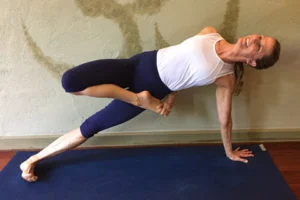
Pose of the Month: Kasyapasana (Half Bound Lotus Side Plank)

Kasyapasana

The pose dedicated to the sage Kasyapa.

Any of the postures dedicated to a sage are among the most difficult poses to work on. They are often arm balances like Kasyapasana, and they take persistence. They are also among the most gratifying to achieve because of the hard work and dedication you have to put in to get them.

You already know yoga is transformational: The practice strengthens your body, focuses your mind, and tempers your nervous system. But the most powerful shift occurs when you realize you can do something you didn’t think was possible. And when you exceed your own expectations, you feel a sense of empowerment that flows into every facet of your life.

For many students this occurs when they finally achieve an arm balance. Watching someone perform a challenging pose can be inspiring, and they may make it look deceptively easy. The process of breaking down a posture and working on its individual parts can be a fun challenge if you allow it to be.

Kasyapasana is a combination of Side Plank and Half Lotus with a bind. Most arm balances require core and shoulder strength. But this arm balance also requires hip and shoulder flexibility. The other unusual thing about this particular arm balance is that in most poses that include Half Lotus, the hip is flexed. This makes it easier to bind the foot. Kasyapasana makes it more challenging by extending the hip.

To work on this arm balance, we will work on the following poses:

For the core strength: Side Plank and Side Plank with Tree Variation