Pose of the Month

Restorative Poses – Cobbler’s Pose

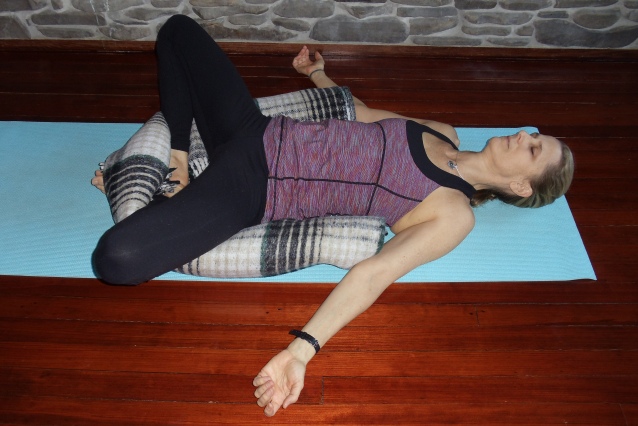
Supta Baddha Konasana

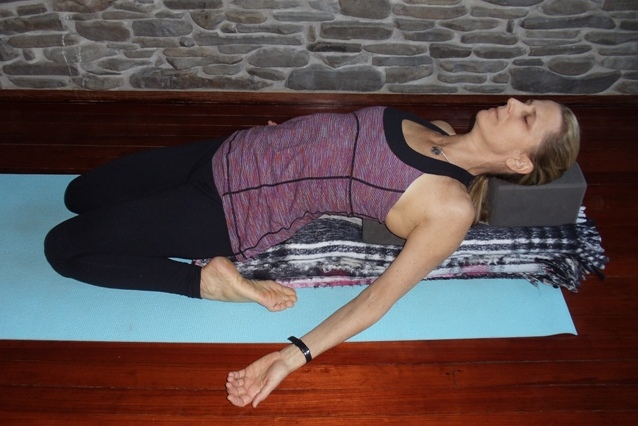
Supta Baddha Konasana

Supported Cobbler’s Pose is one of the most important restorative poses. Physically it opens the chest, abdomen and pelvis. These areas are often restricted by how we sit and stand, the shape of our chairs, the fit of our clothes and how much time we spend looking down into our hand-held electronic devices. Psychologically, this pose allows for deep opening with safety and support. In the Yoga Sutras Patanjali writes about hiranyagarbha, the great golden womb of the universe. Patanjali teaches that the entire universe is held within this golden womb.  As you practice Supported Cobbler’s Pose allow yourself to enter into this primordial space of complete rest and ultimate protection.

There are many versions of Reclined Cobbler’s Pose. In the picture, I am demonstrating the simplest. I have used a long rolled blanket folded in a “U” shape around my feet and hips to help draw my legs towards my torso and cradle them there. In this version, I am lying flat on the floor. This is nice to do lying on a carpeted floor with a blanket over you to keep warm. Use an eye-pillow if you have one. Put on some soothing music, if you like and set a timer for anywhere from 5 to 15 minutes. I have been playing a choir singing the mantra So-Hum. You can find it here on youtube.

Restorative Poses

For the month of December we will focus on restorative poses.

That doesn’t mean that we will turn our vinyasa classes into restorative classes. It just means that we will include a restorative posture during every class.

Some students have a hard time with restorative postures. They might not see their value. After all, you are not really “doing” anything in a restorative pose. But, restorative poses are deceptively effective if you give them a chance.

Take Reclining Hero Pose, for example:

Supta-Virasana-4-x-6.jpg

Some students can lie down in this pose fairly easily, but can’t hold it for 2 minutes. That is an example of what I would call deceptive flexibility.  This is when you can force your body into a position but you cannot maintain it because it is not comfortable. You are not really that flexible. That is an example of “doing the pose”. If you can cultivate a sense that you could be in a posture forever, then the pose can do you. Your body can reap the benefits of the pose and you can reset your resting muscle length.

If you are willing to experiment with props and support your body in a pose, you can cultivate a sense of serenity and equipoise in a pose and you might feel that you could stay forever, or at least 2 to 3 minutes with ease. In modern exercise physiology we have learned that you need to hold a stretch for between 30 and 120 seconds in order to change the resting length of your muscles.

Restorative postures are the perfect balance to busyness; the perfect antidote for this holiday season. Give them a try this month.

Vinyasa Pose of the Month – Dancing Warrior Series, or going with the flow.

The weather feels as if it is finally changing to fall. What better way to help our bodies through this transition than to focus on transitions from one yoga pose to the next. We can use the flow of yoga poses to help keep us warm as our bodies adapt to the change from the unseasonal warm temperatures we had been experiencing to the more seasonal temperatures of November.

Instead of focusing on a single pose for the month of November, we are going to with the flow. Our focus will be on Vinyasa Flow. Expect to see Sun Salutes, Moon Salutes, Dancing Warrior Series and other transitions linking poses together.

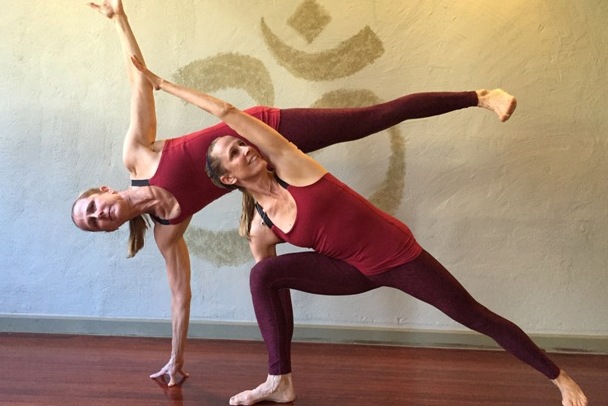
Side-Angle-to-Half-Moon-transition-web-large-4-x-6.jpg

In general, yoga practice builds strength and flexibility. But you can shift the focus of your practice by doing static poses for long holds or by constantly moving and flowing from one pose to the next. Long holds of single poses builds patience, stamina, endurance, perseverance and awareness of the body in space. This is a great practice for times when you feel scattered and need to get grounded. Flowing sequences build trust, confidence and coordination. A practice that focuses more on movement can energize you when you are feeling stuck or sluggish, or it can let off steam when you feel ready to burst from excitement or tension.

Just because we will be flowing more this month, please don’t throw your alignment to the wind! The word vinyasa means to place or step carefully, so as we move from one pose to the next, let your movements be thoughtful and considered. Sun Salutations are said to be a body mantra. Think of this type of a practice as a physical prayer and move through your practice as if it is an offering from your heart.

While I never think of yoga as a weight loss program, I did schedule this practice for now when there are many temptations to over-eat, or to eat less healthy. I love the way this type of practice makes me feel afterwards. I often feel clean and detoxified which makes me want to be careful about what I eat after.

I saw a sign outside of a gym the other day that said: “The average person gains 5 pounds between November 1 and January 1.” Yikes! A little scare tactic to get you into their program. However, if we are not mindful about what we eat, we could easily fulfill this statistic. Remember that yoga should be done on an empty stomach. And after your workout, when you are ready to eat, make sure you replenish your muscles with some protein. Avoid the temptation to go for empty calories that only leave you craving more later. Eating mindfully and healthfully is an important part of my yogic lifestyle.

Pose of the Month for October– Eka Pada Koundinyasana I

Eka-pada-koundinyasana-karin-4-x-6.jpg

Eka = One
Pada = Leg or foot
Koundinya = the name of a sage

Eka Pada Koundinyasana is a twisting arm balance. It is traditionally entered into from tripod headstand but you can also get into it from Side Crow or Revolved Side Angle. And, if you know me, there are ways to prop yourself into the pose so that you can get a feel for the posture. This pose, like all of the poses named after sages are challenging, but they can be broken down step by step and made approachable.

Since Tripod Headstand and Side Crow are entry points to this pose, you will definitely see these poses in class this month. But it is possible to break the pose down into even simpler parts.

The two main components of this pose are the twist and the arm balance. We can begin to work on basic twists; everything from simple Seated Twist, Lunge Twist, Revolved Chair Pose, Revolved Triangle, Revolved Side Angle, Standing Hand to Big Toe Pose Twist, Lying Hand to Big Toe Pose Twist and Intense Stomach Churning Pose.

To develop the arm balance we need to work on strength in poses like all of the Plank variations, Caturanga, Crow, Side Crow, Lolasana, Tolasana and Tripod Headstand.

Another aspect of what is required from you to do the pose is a conscious level of engagement. One of the ways I learned this was through the topics of Muscular Energy and Organic Energy. Muscular Energy is the ability to hug the muscles towards the bone, to draw in towards the midline and to draw into a central focal point. This is the ability to consciously engage the muscles. It involves strength. But it needs to be balanced by Organic Energy which is the ability to extend outward from a central focal point, away from the midline and out to the tips of the extremities. Muscular Energy and Organic energy need to balance each other in every pose. Muscular energy provides stability and boundaries, but unless it is balanced with Organic Energy it can cause contraction and hardening. Organic Energy provides lightness and space. If it is not balanced with Muscular Energy it can cause over-extension and instability.

This ability to engage all of your body parts in a pose is challenging and the sign of an advanced practice. It is that proprioceptive sense to know what the leg up in the air in Half Moon Pose is doing while you are trying to maintain your balance. This is exactly what is necessary to the next level in poses. I sometime say, “Imagine you are a statue and I could pick you up and move you from one spot to another and your pose wouldn’t fall apart.”

This is the sort of thing we work on when you lift one leg in Down Dog Split and the rest of your pose doesn’t waiver. To work on this quality we will play with leg variations in Tripod Headstand. When you lower one leg towards the floor in Tripod Headstand, the other leg maintains its position while reaching up. If the leg that is reaching moved with the leg that is lowering, you would fall to the floor. It is the reaching leg that balances the lowering leg much like a seesaw.

The Benefits of Eka Pada Koundinyasana

Like all twists, this pose massages the abdominal organs. The spinal twist rejuvenates the spine. The arm balance actions strengthen the arms and neck.

You can see that whether you do the full pose or not, there are plenty of actions, principles and easier poses to work on along the way. Also, while working on the pose you will reap the benefits of the pose.

I can’t wait to get started. I’ll see you in class!
Vinyasa Pose of the Month - Salabhasana or Locust Pose

Salabha means a locust, grasshopper. The pose is said to resemble a locust resting on the ground.

Salabhasna is a beginning back bend. It builds the strength in the back body to prepare for all of the other back bends. Although it is called a beginner’s pose, it is not that easy to do. Because we spend so much of our time hunched forward, it is often difficult to arch back. The muscles on our back body become atrophied from disuse.

Technique:
Begin by lying on the floor in the prone position. Stretch the arms back.

On an exhalation, simultaneously lift the head, chest and legs off the floor as high as possible. The arms are stretched back alongside the body and lifted off the floor as well. The body weight rests on your abdomen.

Contract the buttocks and stretch the thigh muscles. Keep both legs fully extended and straight.

In the beginning it is difficult to lift the chest and legs off the floor, but this becomes easier as you grow stronger. There are modifications to make it easier: lifting just the front body, lifting just the back body, lifting the opposite arm and leg, lifting one arm and the opposite leg and using props to support the chest or the legs.

The benefits of Salabhasana
This pose is said to aid digestion, relieves stomach problems, improves the function of the bladder and prostate and helps cure flatulence. Arching the back in this way improves elasticity in the spine and can relieve pain in the sacral and lumbar areas. Mr. Iyengar states that regular practice of this pose can help people with disc problems without recourse to surgical treatment.

After all of the other challenging poses we have worked on this year, you may be wondering why I chose Salabhasana. One reason is that it is the one basic back bending pose from which your ability to do all other backbends originates. The other reason has to do with a new word that has been introduced in the English language: “i-hunch”; that head forward position we assume when we are looking at our phones. We are spending more and more time hunched over our electronic devices and it is affecting our posture. Salabhasna is a counter-pose, a remedy if you will, for i-hunch!

Where can we go from here?
Salabhasana is the foundation for other back bends such as Bow, Camel and Wheel. But the strength it develops in the back is also important for Caturanga and the lift you need in Forearm Balance and other arm balances such as Scoprion. So, expect to see some of these other poses in the more advanced classes as we work on Salabhasana to set the foundation.

Pose of the Month for August - Transition from Prasarita Padottanasana to Sirsasana II

Sirsasana II with wide legs

Sirsasana II with wide legs

This month our focus will be on two poses;  Wide Legged Forward Fold (Prasarita Padottanasana) and Tripod Head Stand (Sirsasana II).  We will work on each one separately and on the transition from one to the other.

In Wide Legged Forward Fold we will be working on the flexibility of the hamstrings and inner thighs as we work on elongating the torso and getting the head to the floor.  This pose prepares you for Head Stand by getting the head lower than the heart and getting you accustomed to having the head on the floor.  If you don’t do Head Stand this is a good alternative or a preparatory pose.

We will also work on Sirsasana II.  This is Tripod Head Stand where the head and hands are on the floor and those three points form the points of an equilateral triangle.  Sirsasana II takes more arm and shoulder strength while Sirsasana I takes more shoulder flexibility. Some people prefer one version of Head Stand over another, however, they each have their purposes and functions and it is nice to be well versed in both.  Mastering Sirsasana II is important for performing many of the arm balancing postures such as Crow, Galavasana and the Koundinyasana variations.

The alignment of the head, neck and shoulders are important in Head Stand.  No matter which Head Stand you are in the part of the head that should be on the floor is the very top of the head.  To find this spot, place the heel of your hand on the bridge of your nose and then stretch your fingers up over the top of your head.

Sirsasana-measurement-I-web-large-square.jpg
sirsasana-measurement-II-web-large-square.jpg

The spot where your middle finger touches is the spot that should rest on the floor in Head Stand.

The head and torso should be in a straight line when you are coming into Head Stand so there is no strain on the neck.

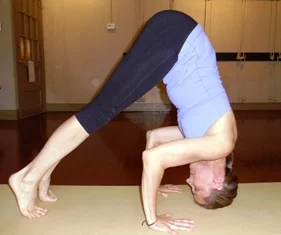
Dolphin

Dolphin

The transition from Wide Legged Forward Fold to Head Stand requires a lot of core strength and stability so expect to see some abdominal work and some plank work.  If you are not a person who likes working on your core because it just seems hard, let me encourage you to stick with it.  There is a big payoff here when you can finally float your feet off the floor and move into Head Stand. It can be an exhilarating and empowering experience.

While we are always looking for the balance of effort and ease in every pose, in the beginning these transitions feel hard and students are tempted to grit their teeth and hold their breath.   If you ever find yourself gritting your teeth in a pose it might mean that you are trying too hard and trying to force yourself into the pose.  That is a signal to back off, breathe and try again.  Wait for the pose to come to you.  Holding the breath while in Head Stand is contraindicated because it can build up too much pressure in the head and the eyes in particular.

We will work on the transition to Head Stand in Stages:  First, we will practice Dolphin, then bent knees:

Sirsasana-II-prep-Dolphin-stage-2-web-large.jpg

And finally moving up into full Sirsasana II.  We will also work on coming down from Head Stand.  Coming down is easier than going up and it is how you learn control.

As always, remember to breathe and honor where you are, have fun and be playful as you experiment with your edges.  Develop a curious sense of exploration and see where it takes you.

I look forward to seeing you in class!

Karin

Pose of the month for July - Visvamitrasana

Karin in Visvamitrasana

This pose is named after an ambitious king who became a sage by a lot of hard work. This pose is a variation of Vasisthasana, who was the sage that king Visvamitra was trying to outdo. The yoga pose reflects the story behind it; Visvamitrasana is a much harder posture than Vasisthasana, better known as Side Plank. This posture incorporates the elements of a standing pose (think Hand to Big Toe Pose), an arm balance (Side Plank), a big side stretch (Gate Pose), a big twist (Revolved Seated Tree) and a major hamstring stretch (Split). Don’t look at that list and get intimidated. It just means that we will work on all of those elements, bit by bit, to get to the final pose. There are also many variations, options for props and entry level versions on the way. We will just take it one step at a time and warm up to the final pose. As we work on Visvamitrasana this month, remember: “It’s nice to have and end to journey toward, but it is the journey that matters in the end.” – Ursula LeGuin.

I can’t wait to get started! I’ll see you in class. Karin

Pose of the Month – Natarajasana, or Dancer's Pose

Dancer-web-large.jpg

Nata means dancer
Raja means lord or king.

Natarajasana, is the name of the pose dedicated to Lord Shiva, the Lord of the Dance. In his Himalayan abode on Mount Kailasa and in his southern home, the temple of Chidambaram, Shiva is said to dance. The god created over a hundred dances, some calm and gentle, others fierce and terrible. The tandava is the fierce, violent dance, signifying the destruction of self-limiting awareness; and lasya is the gentle, lyric dance in which Shiva reveals the beautiful, loving, and tender aspects of existence. Shiva, as Lord of the Dance has inspired some of the finest Indian bronzes and sculptures.

As we prepare for Natarajasana this month we will need both fierceness and playfulness.

Natarajasana is quite an advanced pose. Mr Iyengar rates it a 58/60; one of the most advanced poses in Light on Yoga. To prepare for it we need to open the front body: the shoulders, heart, belly and the fronts of the thighs – quads and psoas. We also need to strengthen the back body: the glutes, hamstrings, middle and upper back. We also need to find strength and stability without rigidity combined with a grounded sense of playfulness and open-heartedness.

There are 2 version of Dancer’s Pose that make this asana more accessible to every student. One is what I would call Baby Dancer where you reach back for the bent leg with your arm behind you as in Bow. The gateway pose for this version is Bow Pose. The full version of Dancer’s Pose is where your arms reach over your head for the bent leg foot. The gateway pose for this version is Dwi Pada Viparita Dandasana (Wheel on your forearms with your legs straight).

Notice how both of the poses I mention as gateway poses are symmetrical postures. That is because it is much easier to do symmetrical poses than it is to do asymmetrical poses. Once these poses are mastered you can begin to play with asymmetrical versions of these poses.
Another important pose for this sequence is Virabhadrasana III, or Warrior III. The ability to balance on one leg gives us the strength and steadiness for Natarajasana.

Let’s approach this posture fiercely and playfully. Come to practice ready to work and play. I’ll see you in class! Karin
Growing a Lotus

Karin in Padmasana

“May I learn to live like the lotus flower, content in muddy water.”

Lotus Posture, or Padmasana, is one of the quintessential yoga poses.  You can just picture a yogi sitting with legs crossed, eyes closed and meditating blissfully.  Ironically, Lotus is not a pose that is taught very frequently in yoga classes; at least in Western yoga classes.  Most Westerners have tight hips and cannot do this pose.  Some yoga studios caution against teaching it because people hurt their knees by trying to force themselves into the pose.

With that caution, we will work on Lotus this month. I recommend that you proceed mindfully and pay attention to your knees.  There is a modification for every pose.  (The basic modifications for Lotus are: Easy Pose, Half Lotus and Double Pigeon.)  If you feel any strain in your knees, back off, take a modification and let it go until the next time when you can try again. This is the muddy water referred to in the quote; being okay when things don’t work out as you planned, or when things don’t happen when you want them to. Wait. Patiently. All is coming.

Below is a list of some of the poses we will be working on to help us get into Lotus Pose this month.

Easy Crossed Legs Pose
Warrior II
Side Angle
Triangle
Tree
Standing Half-Lotus Forward Bend
Frog
Gate Pose
Pigeon
Double Pigeon
Cobbler’s Pose
Seated Wide Leg Forward Bend
Revolved Seated Tree
Seated Half Lotus Forward Bend

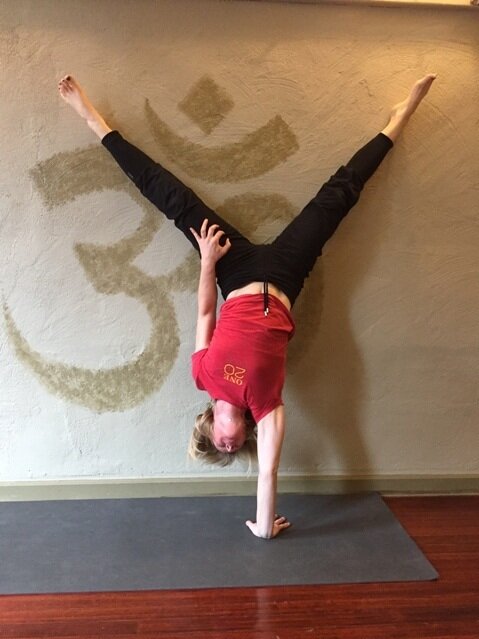
Pose of the Month - One Arm Handstand

Anna in One Arm Handstand

Anna in One Arm Handstand

Practicing Inversions.
Developing Equanimity.

One of the things that makes yoga different from any other form of exercise is the practice of going upside down. Inversions are not for everyone and there are precautions to follow to be safe.  The body has to be trained by the other poses and the student has to develop the awareness and sensitivity to know where the body is in space and what it is doing.   But, inversions are very internalizing postures and they powerfully focus the mind.

Balancing postures, in general, develop poise.  Hand balancing poses such as handstand build confidence and strength.  Because our upper limbs metaphorically connect us to each other, arm balances can strengthen these connections as well as help us maintain healthy boundaries.  Hand balances can be very empowering postures, but they can also be very intimidating to new students.  It is important to practice patience and proceed with caution.

While there is a certain amount of upper body strength required to move into Handstand.  The posture is not as much about hard work and pushing, as much as it is about moving toward ease.  The first thing to learn is to let go of fear and anxiety and begin to learn to find balance in the center of the skeleton.  Think of stacking your bones like so many building blocks.  In Handstand, you line up your forearms right under your upper arms so that your elbows are articulating in full extension and straightness.  When your upper arms are in line with your torso and your torso is in line with your legs, your skeleton maximizes your ability to support your weight.  This articulation takes some time to reach since your joints need to open up and your muscular body needs to support you.  It is important to master this basic skill before moving into the pose variations.  The flexibility to extend the arms in line with the torso is developed in the various positions of the arms in the standing poses.

While the pose of the month is one arm Handstand, it is important to work up to it progressively.  The action of the arms starts in Child’s Pose, progresses to Downward Facing Dog and moves into two arm Handstand.  As a rule of thumb, it is a good idea to be able to hold regular Handstand for a full minute with your arms completely straight, stacking the bones for stability and ease before you think about trying to balance on one arm.  Other benchmark skills are one minute Side Plank and the ability to do pushups.

Last month when we were working on Astavakrasana, one student finally got into the pose after 15 years of practice.  When I was searching up one arm Handstand online, I read one person’s story about how it took him 14 weeks of practicing four to six hours a day, six days a week.  Results are faster the more you practice, but this is just to remind you not to expect results in one day.  Whether your goal is to get into Handstand or one arm Handstand, patience and perseverance are important.  And, achieving the pose is not important.  As Krishna says to Arjuna in the Bhagavad Gita:

You have the right to your actions,
But never to your action’s fruits.
Act for the action’s sake.
And do not be attached to inaction.

Self possessed, resolute act
Without any thought of results
Open to success or failure.
This equanimity is yoga.
BG 2.47-48