Doing it Right

Doing It RIght

In the book, “How Yoga Works,” Miss Friday is working with her student, the Captain.  The Captain comes to yoga as a lot of us do, to help us get out of pain; in this case back pain. He has been working with his teacher for a little while and he is pleased with the progress he is making.  But, as he practices Miss Friday sees that he is cheating in Pascimottanasana (Seated Forward Bend).  He is feeling a little pride in his practice because he can already touch his head to his knees in this seated forward bend.  But Miss Friday stops him.  He doesn’t understand why she stops him. But she tells him that he is cheating because he is bending his knees and rounding his spine in order to get his head to touch his head to his knees. (a common cheat)  She warns him that his both his back and legs are supposed to be straight.  She describes the correct bio-mechanics of hinging from the hips and not folding at the waist.  She tells him that they are doing the practice to make his back healthy again, not to make sure that he can touch his head to his knees.

Y.S. I.14  Your practice must be done correctly, for then a firm foundation is laid.

Miss Friday tells the Captain: “You see, the point is not what the pose looks like in the end.  It’s the process of the pose as it goes on; it’s what it does inside of you, how it works to begin to straighten and open your channels.   These are the channels of how energy flows in the body.  (More about that in another post!) Miss Friday goes on to say:  “But if you don’t do the pose right, if you cheat, if you try to trick the pose and get around it just so you look good, then the pose doesn’t work on you the way it is supposed to.”

She asks him to do the pose, again, without bending his knees, which he does.  It’s a beautiful pose, his back is straight, his legs are straight and he is hinging at the hips.  But the Captain is unhappy because his head is about 2 feet from his knees!

Pascimottanasana-do-and-dont.png

We are often like the Captain, impatient in our progress and mistaking what it not important for what is important.  Often a student sees someone do a very advanced Pascimottanasana and sees that their head is touching their legs, so they think that is important, but what they don’t see is the straightness of the legs and the long, almost straight line of the back.  It can take a long time to get to that stage of practice with a lot of hard work and true understanding of what is going on in the body.

Pascimottanasana-4-x-6.jpg

One of the things I love about the study of yoga and the stories and mythologies that it uses to teach us is that we are meant to see ourselves in every character of the story.  Can you see yourself as the Captain?  Can you see yourself as Miss Friday?  Sometimes it is hard for us to recognize ourselves as the Captain, especially if we don’t like what we see.  But, we are also meant to see ourselves from a different perspective.  That way we can see if we are cheating ourselves and examine why.  Pride?  Envy?  Impatience?  While Impatience is not one of the Seven Deadly Sins from Christianity, or the Six Enemies of the Heart from the Yoga Sutras, as are pride and envy, it still has a way of blocking the channels and stopping progress on the path.

In the Iyengar style of yoga that I study and teach, the focus is on doing the poses correctly, to open the channels of energy in the body to create an optimum flow of healing energy.  It's a method that has worked for me.
The Trouble Tree

The Trouble Tree - author unknown

The carpenter I hired to help me restore an old farmhouse had just finished a rough first day on the job. A flat tire made him lose an hour of work, his electric saw quit, and now his ancient pickup truck refused to start. While I drove him home, he sat in stony silence.

On arriving, he invited me in to meet his family. As we walked toward the front door, he paused briefly at a small tree, touching the tips of the branches with both hands. When opening the door he underwent an amazing transformation. His tanned face was wreathed in smiles and he hugged his two small children and gave his wife a kiss.

Afterward he walked me to the car. We passed the tree and my curiosity got the better of me. I asked him about what I had seen him do earlier.

"Oh, that's my trouble tree," he replied." I know I can't help having troubles on the job, but one thing's for sure, troubles don't belong in the house with my wife and the children. So I just hang them on the tree every night when I come home. Then in the morning I pick them up again."

He paused. "Funny thing is," he smiled, "when I come out in the morning to pick 'em up, there ain't nearly as many as I remember hanging up the night before."

The story of The Trouble Tree reminds me of a sermon I remember from my childhood. The pastor of a parish in a small town was frustrated with his parishioners always complaining about their problems. He didn’t know how to help them. But, one day he had an idea. He asked everyone to write their problems out on a card and tie them to a tree. After everyone did this, he invited the townspeople to walk around the tree and pick any card off the tree that they wanted to. The idea was that they could trade their problems in for somebody else’s. I remember getting excited about this as a kid. I fantasized about trading in my imperfect world for the world of my dreams. I was dumbstruck when the priest said that after everyone walked around the tree and looked at everyone else’s problems, they realized that their lives were not so bad after all. Everyone had problems. This simple act made people remember to count their blessings and to be more compassionate with their neighbors, where before, they may have been envious of them.
This was a great lesson for a young girl and perhaps the beginnings of my life as seeker. What is your earliest memory of a great lesson you learned that has helped shape your life and who you have become?

Love yourself. Be compassionate with yourself on your journey. And always remember to be grateful that you have a journey to be travelling on.

The Queen of Asanas

Sarvangasana or Shoulder Stand

Shoulder Stand is a posture that is not often taught in yoga classes. To do it properly and safely requires the use of props for most people. The way that I prop for Shoulder Stand follows a traditional Iyengar set-up; 2 to 3 blankets, a belt, a block and a mat for each person. A lot of studios simply do not have enough props. But, in addition, students have to be taught how to use the props and how to set them up precisely for maximum benefit. Unfortunately, I have been in many yoga studios where it is clear that students as well as teachers do not know how to properly fold a blanket or even buckle a belt. Also, many yogis often see props as a sign of inadequacy and their use as beneath them. I see props as an enhancement to my yoga practice, an assist when needed and as tools to teach the body optimum alignment.

Unfortunately, Shoulder Stand has a reputation for being a dangerous pose for people’s necks. If you ask someone to stand up straight and bend their head forward, you will see that no one’s neck can bend at 90 degrees. The normal range of neck flexion is 60 degrees. In order to do Shoulder Stand safely, the shoulders and upper arms must be lifted off of the floor sufficiently to allow the neck to bend at its’ comfortable limit. Doing Shoulder Stand without props can put undue force on someone’s cervical vertebrae and this could be injurious to the neck.

Often students ask why they should practice Shoulder Stand. It seems that they are asking why they should bother with all of the props. Shoulder Stand is considered the Queen of asanas and it has many benefits. It is an introspective posture, all you can see is yourself (you are not meant to turn your head); it is also cooling, nurturing and feminine in nature. If you read in Light on Yoga, Mr. Iyengar lists many benefits for Sarvangasana. He says:

“Sarvangasana is the mother of asanas. As a mother strives for harmony and happiness in the home, so this asana strives for the harmony and happiness of the human system. It is a panacea for most common ailments. There are several endocrine organs or ductless glands in the human system which bathe in blood, absorb the nutrients from the blood and secrete hormones for the proper functioning of a balanced and well developed body and brain. If the glands fail to function properly, the hormones are not produced as they should be and the body starts to deteriorate. Amazingly enough many of the asanas have a direct effect on the glands and help them to function properly. Sarvangasana does this for the thyroid and parathyroid glands which are situated in the neck region, since due to the firm chin lock their blood supply is increased. Further, since the body is inverted, the venous blood flows to the heart without any strain by force of gravity. Healthy blood is allowed to circulate around the neck and chest. As a result, persons suffering from breathlessness, palpitation, asthma, bronchitis and throat ailments get relief. As the head remains firm in this inverted position, and the supply of blood to it is regulated by the firm chin lock the nerves are soothed and headaches, even chronic ones, disappear. Continued practice of this asana eradicates common colds and other nasal disturbances. Due to the soothing effect of the pose on the nerves, those suffering from hypertension, irritation, shortness of temper, nervous breakdown and insomnia are relieved. The change in bodily gravity also effects the abdominal organs so that the bowels move freely and constipation vanishes. As a result the system is freed from toxins and one feels full of energy. The asana is recommended for urinary disorders and uterine displacement, menstrual trouble, hemorrhoids and hernia. It also helps relieve epilepsy, low vitality and anemia. It is no over statement to say that if one practices Sarvangasana they will feel new vigour and strength and will be happy and confident. New life will flow into the body, the mind will be at peace and the practitioner will feel the joy of life. After a long illness, the practice of this asana regularly, twice a day, brings back lost vitality.”

We will work on Shoulder Stand this month and then next month we will work on Head Stand.  Since these two poses are meant to be practiced together, as counter poses to each other, we will continue to include Shoulder Stand in our practice.  According to the Iyengar tradition, you can practice Shoulder Stand by itself, but if you practice Head Stand, you should finish your practice with Shoulder Stand.

The Twelve Days of Christmas in Yoga Poses

A Holiday Yoga Practice

Here are the poses for the Twelve Days of Christmas practice that I taught this week.  It’s a nice practice for home and it doesn’t have to take 90 minutes; you can tailor the practice to the time you have. (To make it shorter, skip the repetitions and hold for shorter times.)  I have done this practice several times recently.  It’s a nice well rounded sequence that includes balance poses, core engagement, twists, hip opening, hamstring stretches, back bends and prepares you nicely for the final postures of Dancer’s Pose and Split.

Do this practice if you have trouble getting to your yoga class over the Holidays.  Enjoy!  And let me know how it went in the comments below.

A Partridge in a Pear Tree:
Tree pose – hold for 1 minute on each side.  Try balancing while listening to Cheech and Chong’s Santa Claus and His Old Lady

2 Turtle Doves:
Warrior 2 – hold for 1 minute on each side.

3 French Hens:
Warrior 3 – hold for 5 breaths on each side.

4 Calling Birds:
Plank – hold for 1 minute.

5 Golden Rings:
Boat – 5 times, holding for 5 breaths each time.  Cross your legs and lift up after each one.

6 Geese a Laying:
Pigeon – hold for 2 minutes each side.

7 Swans a Swimming:
Bow – 3 times, 5 breaths each time.  Roll to the right and left for added benefit.

8 Maids a Milking:
Cow Face Pose – hold for 1 minute each side.

9 Drummers Drumming:
Revolved Side Angle Pose – 3 times, knee down with hands in prayer the first time, knee up hands in prayer the second time, full pose with arms (if possible) for the last one.

10 Pipers Piping:
Standing Split against the wall – 3 times.  Start in Down Dog with your heels 1 foot away from the wall.  Take your right leg up, right foot on the wall in Down Dog Split, hold for 5 breaths,  change legs.  Repeat 2 more time getting closer and closer to the wall each time, if you can.

11 Ladies Dancing:
Dancer’s Pose – Use a belt to hold your foot with your arms over head.  Or, simply reach back and do Baby Dancer’s Pose.  5 breaths each side, or until you lose balance – whichever comes first.

12 Lords a Leaping:
Split – 3 times, 5 breaths each side.

I used to teach this sequence in typical "12 Days" fashion: pose 1, pose 2 - 1, pose 3 - 2 - 1, pose 4 - 3 - 2 - 1, ...  It was hard and sweaty and extremely repetitious.  Plus, form suffered!  So I changed it to do 12 poses inspired by the song without counting down each time.

Happy Holidays!

Book Review – Can’t Hurt Me by David Goggins

Bood Review - Can’t Hurt Me by David Giggins

I have enjoyed listening to all 13 hours and 38 minutes of David Goggins’ story in his book Can’t Hurt Me.  It describes how he pulled himself out of what he calls the sewer and becomes a Navy Seal.  He describes what he did to acquire the mental toughness to overcome the abuse he suffered from his father, how he overcame poverty and racial prejudice to achieve the goals he set for himself.  How he did not accept the victim mentality and let his life be defined by others.  He refused to become a statistic.

David Goggins  states that most of us live very comfortable lives and operate at only about 40% of our capability.  He writes in detail about how he went from weighing 305 pounds working a dead end job setting rat traps and spraying for roaches at night in restaurants for an exterminating company to becoming one of the Navy’s most elite and fit fighters.  He also became an elite ultra marathon runner and is now working as a wildfire firefighter in Montana.

While Davis’ book is inspirational, he doesn’t want the reader to simply be inspired by him, he wants the reader to recognize that they are capable of so much more.  While his book is a memoir, it is also a self-help book.  In it he outlines 10 steps, or challenges, for the reader to take on.  One of the reasons I liked this book so much is that it really describes the yogic path.  I know that some folks think that the yogic path is supposed to be soft and gentle.  I have always felt that the path of yoga always asks us to do the harder thing and not to take the path of least resistance.

  1. Get real with yourself: Name the enemy.

    1.  Satya, or truthfulness.  In this instance, with yourself.

  2. Check in with your accountability mirror daily.

    1. This is the principle of svadhyaya, or self-study.  Are you really walking the talk?

  3. Visualize success.

    1. You have to know what you want in order to work towards it.

  4. Don’t skip out on the last rep when you are training. Finish when you are done, not when you are tired.

    1. This is the yogic practice of abhyasa which means consistent practice over a long period of time. whether you feel like it or not.

  5. Apply progressive overload not just in your workouts, but in your life.

    1. Again, this is abhyasa.

  6. Celebrate your success with work.

    1. Don't fall of the path to celebrate.  Celebrate by staying on the path.

  7. Know why you are in the fight to stay in the fight.

    1. The power of setting an intention.

  8. Use your past successes to create your own second winds.

    1. Again, this is part of svadhyaya, or self-study.

  9. You will feel alone. You will feel insecure.  Get over it.

    1. Patthabi Jois used to say that yoga is 99% practice and 1% theory.  Mostly it just consists of you, your mat and your life off of the mat.

  10. The harder you try the harder your life becomes – to your benefit.

    1. This is the principle of tapas, which means to burn with zeal.  Medical intuitive and spiritual teacher Caroline Myss says that life is easier with your head in the sand.  Walking the spiritual path, with your eyes open is so much harder and so much more rewarding.

Men’s Health magazine did a book review on Can’t Hurt Me and wrote in different detail about these 10 steps.  You can read the fleshed out descriptions here and also see some stunning before and after pictures of David Goggins.  They also used some great posts from his Instagram account.  Of course, you can find David Goggins yourself on Facebook or Instagram yourself.

https://www.menshealth.com/trending-news/a25429109/david-goggins-cant-hurt-me-book-review/


Note on adult language:  My mother couldn’t stand books or movies with curse words in them, maybe that is a different generation, but if that is you then don’t read this book.  Mr. Goggins curses like, well, a sailor and the text is filled with F bombs.  However, he writes the way that he speaks and he says that he is just keeping it real and raw, the way his life truly was.

Let me know how you enjoyed this book and what your best take away from it was by leaving a comment below.

Yoga Sutras 3.13 to 3.16 The Final Sutras on the Architecture of Change

Y.S. 3.13  Etena bhutendriyesu dharma laksana avastha parinamah vyakhyatah

Etena   By this
bhutendriyesu  
the elements, body and sense organs
dharma
propriety, law, duty, right, virtue, religion
laksana
character, mark, sign, quality, description
avastha
 condition, state, position
parinamah
change, effect,transformation
vyakhyatah 
visible, described, unfolded, enumerated

Through these three phases, cultured consciousness is transformed from its potential state (dharma) towards further refinement (laksana) and the zenith of refinement (avastha).  In this way, the transformation of elements, sense and mind takes place.

These three stages can be described using a clay pot as an analogy.  The dust that makes the clay is the potential state, the clay itself is the second stage of further refinement and the pot is the zenith of its refinement.  Everything has these same properties.  Can we learn to see these properties and know that everything is in one of these states and in the process of transitioning into the next state, as this process is cyclical.  


Y.S. 3.14  Santa udita avyapadesya dharma anupati dharmi

Santa  Appeased, allayed clamed, quietened, pacified
udita  
rise, ascended, manifested
avyapadesya  
 not defined, latent, lying in potential form
dharma
 propriety, usage, law, duty, religion, virtue
anupati 
closely followed, common to
dharmi  virtuous, just, religious, characterized

The substrata is that which continues to exist and maintain its characteristic quality in all states whether manifest, latent or subdued.

Using the refinement of our yoga practice, we can train ourselves to perceive this.

Y.S. 3.15  Krama anyatvam parinama anyatve hetuh

Krama  Going, proceeding, advancing, regular course, method, order of sequence, succession
anyatvam  
different, distinct
parinama   
change, transformation, effect
anyatve  
different, distinct, variant
hetuh  
cause, reason

Successive sequential changes cause the distinctive changes in the consciousness.


Y.S. 3.16  Parinama matraya samyamat atita anagatajnanam

Parinama change, transformation, effect
traya 
threefold
samyamat  
integration, control
atita  
past
anagata 
future
jnanam 
knowledge

By mastery of the three transformation of nature (dharma), quality (laksana) and condition (avastha), through samyama on the nirodha, samadhi and ekagrata states of consciousness, the yogi acquires knowledge of the past and future.


Know one thing and you can know everything.

Through the process of yoga and meditation we learn to still the mind and focus on one thing; this is called ekagrata, or one-pointed consciousness.  This is the direct opposite of multi-tasking which we are often engaged in.  Multi-tasking is not very productive and can often lead to mistakes or lapses of attention on one thing as attention is diverted to something else.  Yoga asks us to focus, laser-like on what we are doing.  The idea being that we can know everything by learning all we can about one thing.

It is similar to the analogy of digging one 100 foot deep hole rather than 100 one foot deep holes.  Sure, in the beginning you might want to look around for a bit to see which area you want to focus on but once you do, then dive in completely.  The analogy often given in the Yoga Sutras is that of being a potter and making clay pots.  If you put in the requisite 10,000 hours for mastery of your material, then you know the properties of the clay inside and out.  You are able to recognize the potential of the material to become a pot and to also recognize that eventually the pot will one day return to the dust from which the clay was made. This skill involves knowing the properties of the material and the effects of time and place on it.

The importance of these sutras can be demonstrated by the practice of asana, pranayama and meditation.  If we imagine the scattered dust cells of the body and scattered thoughts of the mind and we charge them so that they cohere like a lump of clay, we can feel their inner unity and transform body, breath and consciousness into the shapes of the various asanas as a potter turns a lump of clay into a pot.

In asana, if the energy of the body is harmonized into a single point while in a state of tension, we reach precision.  This single pointed attention indicates the point of balance and harmony at which we can unlock and liberate the knotty confusion of matter and emotion.  It also conveys the importance of finding the exact center of the meeting points of vertical extension and horizontal expansion in body, breath and consciousness.    This is yoga in action.

Restorative Poses for December 2018

Restorative Pose: Reclining Hero

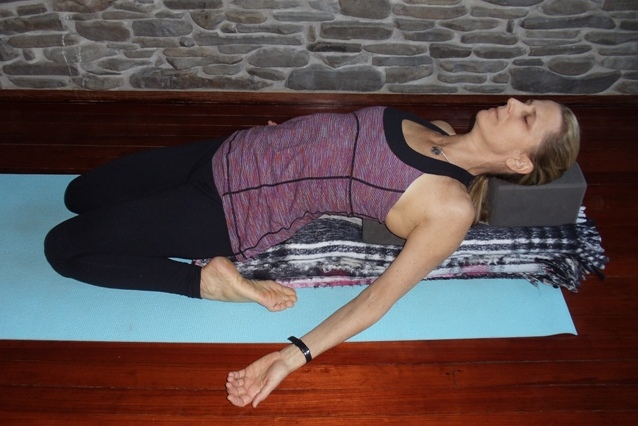
For the month of December we will focus on restorative poses.  That doesn’t mean that we will turn our vinyasa classes into restorative classes.  It just means that we will include restorative postures during every class.  Some students have a hard time with restorative postures.  They might not see their value.  After all, you are not really “doing” anything in a restorative pose.  But, restorative poses are deceptively effective if you give them a chance.  Take Reclining Hero Pose, for example.  Some students can lie down in this pose fairly easily, but can’t hold it for 2 minutes.  That is an example of what I would call deceptive flexibility, when you can force your body into a position but you cannot maintain it because it is not comfortable.  You are not really that flexible.   That is an example of “doing the pose”.  If you can cultivate a sense that you could be in a posture forever, then the pose can do you.   Your body can reap the benefits of the pose and you can reset your resting muscle length.   If you are willing to experiment with props and support your body in a pose, you can cultivate a sense of serenity and equipoise in a pose and you might feel that you could stay forever, or at least 2 to 3 minutes with ease.  In modern exercise physiology we have learned that you need to hold a stretch for between 30 and 120 seconds in order to change the resting length of your muscles.

Supta-Virasana-4-x-6.jpg

In class this month, we will start with Supta Virasana, Reclined Hero Pose, to prepare us for Pinca Mayurasana and various Back Bends.  There are modifications for every ability.  I will offer a choice of set-ups for the pose at the beginning of class.  Learn what props you need to be able to hold the pose for at least 5 minutes.  Please be precise with your props, they can make or break your ability to hold the pose.  And, don’t worry; there are straight leg modifications for those of you with knee issues.

November 2018 Playlist

One of My Most Requested Playlists

This is the playlist I have been using in class this past month.  I usually work with a playlist for a 90-minute class.  The playlist is not exactly 90 minutes because I usually spend a few minutes talking at the beginning of class.  My playlists usually start with pop music and end with mellow yoga music.  I often switch songs in and out until I get the right tweak.   I must have tweaked it just right because several people asked me for this playlist:

Woman by Mumford & Sons
Yellow by Coldplay
What’s Up? by 4 Non Blondes
Go It Alone by Beck
Wow by Beck
I Try by Macy Gray
Crash Into Me by Dave Matthews Band
Royals by Lorde
Adventure Of A Lifetime by Coldplay
How Come by Ray LaMontagne
Glycerine by Bush
Round Here by Counting Crows
Stay by Rihanna
Killing Me Softly by Fugees
Servant Of Peace by Snatam Kaur
Ong Namo Bhagavate by Deva Premal
By Any & All Means by Brad Roberts

1 hour, 25 minutes

For those of you who are on Spotify it is called "My playlist #2"

How to charge for your time as a yoga teacher

The Art of Pricing

Often I get asked by new yoga teachers what they should charge for teaching a specialty class or a private outside of a yoga studio. In this article, I will discuss what to charge for teaching a one off specialty class at some location. In future articles I will address pricing for privates and workshops.

Those specialty pricing questions are often tricky. If you price yourself too high, then you might price yourself out of the job. Too low and you will regret doing it, especially if it is a recurring class. If it is just one and done, then it doesn’t really matter. You’ll learn from the experience whether you felt like you charged the right amount or not and know better for next time.

Some of what you charge depends on whether you really want to do the class or not! However, don’t scalp the person just because you don’t want to do the job. The ethical thing to do if you really don’t want to teach the class is to politely decline and maybe recommend a friend for the job. Sometimes, especially in the beginning, you need to say “yes” a lot. You never know what connections you might make, or which gigs could lead to other opportunities.

It is also ok to do a one-off, specialty classes for free. A friend asked me to teach a class of goat yoga for a fundraiser she was doing. I had never taught goat yoga before and really didn’t know what to expect. Since it was a charitable event I decided to do it for free and donated my time. I googled goat yoga and prepared myself. It was fun and it was a successful event for her but I decided that it wasn’t for me. The next time someone asks me to do goat yoga, I can politely decline and recommend some colleagues.

To figure out your hourly rate it helps to have a formula. What do you get paid at the yoga studio where you work? How does that number feel as an hourly rate? Often, you get paid less teaching a regular, repeating class than you would teaching a one-time private. What does your studio charge for a private with you? If you don’t work for a studio, you can usually inquire what a private session costs at a yoga studio in order to get a ball park. Call around, you may be surprised at the variations! It’s harder to find out what yoga teachers get paid for a class. That info is usually private and it depends on several factors. Yoga teachers make more in big cities than their rural counterparts. Pay also varies with experience and expertise and ultimately how many students you can attract.

Typically yoga teachers anywhere from $20 for a newer, inexperienced yoga teacher up to $100 an hour for a seasoned, popular teacher with a following in a big city. Once you have some of these numbers, you can play with them in a formula and come up with a price.
Let’s say that the class somebody wants you teach for them at their store, arboretum, office or back yard is an hour long. It takes you 30 minutes to get there and 30 minutes to get back. So you have 2 hours of your time invested in this class. If you figure that your hourly rate is $25, ask for $50 for the two hours. If that doesn’t feel like enough, plug in $30 an hour and now you’re up to $60.

Try different numbers until you feel justified in asking for that rate without apologizing. You have to feel comfortable asking for your price because once you commit you cannot change your mind. Also, you have to be just as comfortable with them saying that you are asking for too much money. Individuals and smaller operations typically can’t afford as much as larger business or corporations. But you still have to be able to look someone in the eye and ask for your price. If you can’t do that, then that is a sign that you are not asking for the right amount.
If the commute time, one way, is longer than the amount of time you are actually teaching, you might want to seriously consider passing this off to a colleague. People want to pay you for what you are doing for them, not necessarily for driving to get to them. I’ve taught some classes about an hour from my where I work for the experience and the exposure, but I have never gotten any students from that area as it is just too far for those students to travel to find me and in the end it wasn’t really worth it.

Sometimes people don’t want to pay what I charge for my time and that’s ok with me. I have a lot of training and experience. I’m also fortunate that my schedule is pretty full and that I can’t say yes to every opportunity that comes along. I’ve also learned from being miserable doing something that really wasn’t worth my time. Because I also train yoga teachers, I often can refer other teachers for jobs that I don’t want to do or can’t do. There is also good karma in that, sharing the wealth and opportunities.

As you can see, pricing is an art, not a science. While it helps to have a formula, you often have to go with your gut. And remember that pricing is ultimately an energy exchange. It should feel good to both parties in order for it to work.

Good luck. And let me know in the comments below if this was helpful, or if you have any other questions.

Chapter 3 verses 9 to 12  The First Four Sutras on the Architecture of Change

 Y.S. 3.9  Vyutthana nirodha samskarayoh abhibhava pradurbhavau nirodhaksana cittanvayo nirodha parinamah

Vyutthana  outgoing, emerging
nirodha   
control, restraint
samskarayoh  
conscious imprints
abhibhava  
overpowering
pradurbhavau
to manifest, appear
nirodha
control, restraint
ksana
instant, moment
cittanvayo  
connected with consciousness
nirodha
control, mastery
parinamah 
 development

Study of the silent moments between rising and restraining subliminal impressions is the transformation of consciousness towards restraint.


Y.S. 3.10  Tasya prasanta vahita samskarat

Tasya   Its
prasanta 
 peaceful
vahita 
flow
samskarat
 subliminal impressions

The restraint of rising impressions brings about an undisturbed flow of tranquility.

Y.S. 3.11  sarvarthata ekagratayoh ksayodayau cittasya samadhi parinamah

sarvarthata  on all objects
ekagratayoh 
single-pointed focus
ksaya 
destruction
udaya 
to rise
cittasya 
of the mind
samadhi 
 absolute absorption
parinamah 
transformation

The weakening of scattered attention and the rise of one-pointed attention in the citta is the transformation toward Samadhi.


Y.S. 3.12 Tatah punahsantauditau tulya pratyayau cittasya ekagrata parinamah

Tatah  Then
punah again
santa 
subsiding state, quiescent state
uditau  
rising state
tulya  
similar
pratyayau
cognitions, means of actions, cause
cittasya  ­
of consciousness, mind
ekagrata
 one-pointedness
parinamah  transformation

When rising and falling thought processes are in balance, one-pointed consciousness emerges.  Maintenance of awareness with keen intensity from one-pointed attention to no-pointed attentiveness is ekagrata parinama.

 Commentary

The mind is made up of samskaras (subliminal imprints).  There are two types of imprints: outgoing samskaras that propel the mind into any kind of activity and restraining samskaras which are activated in meditation and restrain the outgoing samskaras.

When we are too distracted by our sensory experience desire, frustration and anger can arise.  These bring disorientation, dissatisfaction and a sense of being ungrounded. Through the practices of  These are all external means of restraining consciousness or the samskaras, whether we focus on God, or the breath, or in asana by learning to direct and diffuse consciousness.

When the restraining samskaras are in effect, the outgoing samskaras lay dormant and vice versa.  In the process of turning inward for meditation, we need to be able to change the normal state of our consciousness from one which is outwardly focused to one that is more internally focused.  We begin this process by practicing the limbs of yoga: yama, niyama, asana, pranayama and pratyhara,  in order to learn to control the effects of external stimuli.

A meditation practice to help restrain the outgoing mind.

This takes tapas (effort).  We sit and make a commitment to stay still.  One practice that helps to turn the mind inward is the practice of following the breath.  In every breath there are four parts: inhalation, pause, exhalation, pause.  During meditation, one can practice by focusing on the easy rise and fall of the breath.  Without trying to change or shape the breath consciously, you simply begin to notice the length of each inhalation and exhalation and allow them to become even.  After a few breaths draw your attention to the slight pause between the breaths.  This pause is often termed “the gap”.  Without grasping for the gap, notice its presence between the breaths.  Sometimes it is possible to slip into that gap in meditation.  Then you are in the state of restraining the samskaras.  This is an early state of meditation and of the experience of Samadhi.  You may experience this pause for a fraction of a second.  And as soon as you notice you are in the gap, it disappears.  But it is a beautiful moment when the mind is still.  Often it is hard to tell how long you may have been in this gap; it could be seconds or minutes.  It is the experience of the present moment just as it is.  This is called ekagrata parinama.  You have succeeded in transforming the mind from being distracted into one-pointed concentration.

Follow this guided meditation for relaxing the body and getting into the gap between the inhalations and exhalations where the mind is still.