Philosophy

What does the Sacrament of Extreme Unction (Last Rites), change and the song "Closing Time" by Semisonic have to do with your seventh chakra?

Last Rites are traditionally given to someone who is preparing to die.  It’s symbolizes the sick person’s acceptance of leaving behind the possessions of his or her life, both physical and emotional.  Extreme Unction is traditionally administered just once, but from a symbolic perspective, in the realm of our own thoughts and feelings, it can be administered once a day, because it signifies our desire to release the unnecessary baggage we carry with us.  It represents the release of all that is dead in our lives, and our conscious choice not to use our life-force to keep alive that which has passed from us.  This sacrament offers us a discipline through which we can live in the present moment.

While you may not have thought as the past as “dead”, this is actually an apt description of the place we call “yesterday”.  Breathing our life-force into keeping the past alive is like choosing to live in a mausoleum.  It is cold and dark, and the dead do not speak to us.

We are not meant to carry the past within us as if it were still alive.  What is over is over, and using our energy to fuel events or relationships long gone is like breathing life into a corpse in hopes of a resurrection. The cost of such actions to both the body and spirit is enormous.

According to Caroline Myss, the sacrament of Extreme Unction is related to the seventh chakra, which represents our connection to eternity and the divine.  The divine truth of the seventh chakra is to “Live in the Present Moment”.  To live in the present moment, we need to surrender and let go.

last-class-at-Treehouse-web-large.jpg

This was brought home very powerfully for me this week as two major changes were unfolding in my life.  One event was the closing of the old Cornerstone, New Hope location and with it the beautiful yoga space at The Treehouse.  Change is always difficult, even if it is just your yoga studio changing locations.  While I was excited about the change, I could see that a lot of the students were not.  You could hear sadness and reluctance in their voices.  The new space is beautiful in its own way, but it’s different.  There will be some things we love about the new space and some things we are not too happy about.  But, regardless, on Monday morning, April 10th, we will be in the new location.  We need to let go of the old space and move on with enthusiasm for that which lies in front of us.

My-mom-and-I-225x300.jpg

The other event was the fact that my mother was moved into Hospice care last week.  I have to contemplate her passing in a much more concrete way.  I actually had to have a conversation with a priest about administering last rites.  While my mother left her home and her possessions long ago, it is now my turn to learn to let go. I need to perform my own ceremony of last rites, of letting go of who I was and that part of my routine which revolved around her.

The inherent energy of Extreme Unction combined with the energy of the seventh chakra, celebrates that all that was good about our past remains alive within us and around us, and that which is dead needs to be dead.  We cannot feel the grace that assures us of our own immortality if we continue to fear and fight the passage of years.

There is a correlation between the two homonyms weight and wait.  The more of the past we carry with us, the heavier our load and the slower our mental, emotional and spiritual evolution.  The lesson of the seventh chakra and the ritual of last rites teach us to dump the contents of our emotional suitcases on the floor as a symbolic release of everything we no longer want to carry with us. 

A healing ritual of Extreme Unction

Begin by asking yourself:  How much energy is draining from me?  How much of the dead am I carrying with me in my daily life?  On a piece of paper, write down whatever dead weight of the past you feel like you are lugging around with you.  Put the paper into a pyrex or earthenware bowl  (on your altar, if you have one) and put a match to it.  As it goes up in flames, visualize yourself dissolving the bonds that have tied you to the incident or incidents and allow your energy to return to you.  Say a prayer in which you release your energy from the event saying, “I don’t want this in my life anymore.”  As you feel your energy returning, say a brief prayer of thanksgiving.

If you have a song or some music that helps you feel the energy of releasing, play it as you perform your ritual.  The song that always comes to my mind when I feel a chapter in my life ending is the song “Closing Time” by Semisonic.  This song was written by Dan Wilson about the birth of his first child and how that event was going to change his life as a rock and roller.

Closing time
Open all the doors and let you out into the world
Closing time
Turn all of the lights on over every boy and every girl
Closing time
One last call for alcohol so finish your whiskey or beer
Closing time
You don't have to go home but you can't stay here

[Chorus:]
I know who I want to take me home
Take me home

Closing time
Time for you to go out to the places you will be from
Closing time
This room won't be open till your brothers or your sisters come
So gather up your jackets, move it to the exits
I hope you have found a friend
Closing time
Every new beginning comes from some other beginning's end

[Chorus:]
I know who I want to take me home
Take me home

Closing time
Time for you to go out to the places you will be from

[Chorus:]
I know who I want to take me home
Take me home

Closing time
Every new beginning comes from some other beginning's end

Letting go of the past is one way we can heal ourselves.   What do you need to let go of?

Lessons of the 2nd Chakra

second-chakra.jpg

The lessons of the 2nd chakra have to do with the power of relationships. The sacred truth associated with this chakra is “Honor One Another”.  The Swadhisthana chakra can also be called the Partnership chakra.  This is where we receive the power to act with integrity and honor within all of our relationships, from marriage to friendships to professional bonds.  This energy is particularly active because it resonates in all financial and creative activity.  Integrity and honor are necessary for health.  When we violate our honor or compromise it in anyway, we contaminate our spirits and our physical bodies.

  1. Meaning

    1. Swadhisthana - One’s Own Place

  2. Location

    1. Sacral area

  3. Principle

    1. Water

  4. Properties

    1. Liquid, flowing, feeling, changeable, yielding, pleasureable

  5. Body Parts

    1. Hips, sacrum, abdomen, sexual organs, large intestine, lower vertebraeinner thighs, knees

  6. Mental and Emotional Issues

    1. Intimacy/emotions

    2. Blame and guilt

    3. Money and sex

    4. Power and control

    5. Ethics and honor in relationships

  7. Physical Dysfunctions

    1. Chronic lower back pain

    2. Sciatica

    3. Ob/gyn problems

    4. Pelvic and hip pain

    5. Sexual potency

    6. Urinary problems

  8. Divine Truth

    1. Honor one another

  9. Affirmations:

    1. I deserve and experience pleasure in my life

    2. I absorb information from my feelings

    3. I embrace and celebrate my sexuality

    4. I move and change easily and effortlessly

Questions for working with the 2nd Chakra

  1. Do you have a lot of creative ideas?

  2. Do you act upon them or deny them?

  3. List your personal creative strengths:

  4. List ways in which you use/express your creativity:

  5. List ways in which you use/express your negativity:

  6. How comfortable are you with your sexuality?

  7. What do you need to do or be willing to do to be sexually well-balanced and to honor your sexuality?

  8. Have you been abused sexually?

  9. Have you abused others sexually?

  10. What is your personal code of honor?

  11. When do you not keep your word?

  12. Do circumstances determine your ethical behavior?

  13. Do you feel that Divine justice influences your life?

  14. How much do you control others:

    1. Sexually?

    2. Financially?

    3. In power plays?

  15. How much power does money have over you?

  16. Do you violate your values for financial security?

  17. How much of your life is dominated by fears of:

    1. Financial security?

    2. Physical security?

    3. Sexual security?

  18. What do you need to do or be willing to do to resolve your fears of:

    1. Financial security?

    2. Physical security?

    3. Sexual security?

  19. What do you need to do or be willing to do to use your creativity optimally?

On a scale of 0 to 10—in which 10 means absolute health with no deficit whatsoever and no lack of full expression of this chakra—how healthy and well-balanced is your second chakra?

The Symbolic Power of the Chakras

According to Caroline Myss:

Eastern religions teach us that the human body contains seven energy centers.  Each of these energy centers contains a universal spiritual life lesson that we must learn as we evolve into higher consciousness.

root chakra.png

These seven spiritual life-lessons direct us toward greater consciousness.  If we ignore our responsibility and need to address consciously these seven spiritual lessons, however, their energy can manifest in illness.  Many spiritual Eastern traditions understand illness to be a depletion of one’s internal power or spirit.  The congruencies among major spiritual traditions underscore the universal human experience of the connection between the spirit and body, illness and healing.

Each of the seven levels of power in our biological system contains a single sacred truth.  This truth continually pulsates within us, directing us to live according to the right use of its power.  We are born with an inherent knowledge of these seven truths woven into our energy system.  Violating these truths weakens both our spirit and our physical body, while honoring them enhances the strength of our spirit and our physical body.

Energy is power and our bodies require energy; therefore, our bodies require power.  When we work with the chakras we are interacting with power and gradually we take control of our own power in successively more intense processes.  At the level of the first chakra, we learn to handle having a group identity and the power that comes within the family; at later levels we individualize and mange power as adults.  Gradually we learn to manage our minds, our thoughts and our spirits.  Every choice we make, motivated by either faith or fear, directs our spirit.  If a person’s spirit is impelled by fear, then fear returns to her energy field and to her body.  If she directs her spirit in faith, however, then grace returns to her energy system and her biological system thrives.

The major spiritual traditions hold that releasing one’s spirit into the physical world through fear or negativity is a faithless act of choosing personal will over the will of the heavens.  In Eastern spiritual terms, every action creates karma.  Acts of awareness create good karma; acts of fear or negativity create bad karma, in which case one must “retrieve” one’s spirit from negative places in order to enter heaven “complete”.

We are simultaneously matter and spirit.  In order to understand ourselves and be healthy in both body and spirit, we have to understand how matter and spirit interact, what draws the spirit of life force out of our bodies, and how we can retrieve our spirits from the false gods of fear, anger and attachments to the past.  Every attachment we hold on to out of fear commands a circuit of our spirit to leave our energy field.  What drains your spirit drains your body.  What fuels your spirit fuels your body.  The power that fuels our bodies, minds and hearts does not originate in our DNA.  Rather, it has roots in divinity itself.

Three truths that are common to the major spiritual traditions are:

  1. Misdirecting the power of one’s spirit will generate consequences in one’s body and life.

  2. Every human being will encounter a series of challenges that test his allegiance to heave. These tests will come in the form of the disintegration of one’s physical power base: the inevitable loss of wealth, family, health or worldly power.  This loss will activate a crisis of faith, forcing one to ask, “What is it, or who is it that I have faith in?”

  3. To heal from the misdirection of one’s spirit, one has to be willing to act to release the past, cleanse one’s spirit and return to the present moment.

In the major spiritual traditions, the physical world serves the learning of our spirits, and the “tests’ we encounter there follow a well ordained pattern.  In the chakra system, each energy center warehouses a particular power.  These powers ascend from the densest physical power to the most etheric or spiritual power.  Remarkably, the challenges we face in our lives tend to follow this alignment as well.

The Lessons of the First Chakra

The lessons of the first chakra are related to the material world.  The first chakra is also called your tribal chakra.  The sacred truth at this level is All is One.  We are interconnected with all of life and to one another.  The tribal chakra resonates to our need to honor familial bonds and to have a code of honor within ourselves.  We first encounter this truth within our biological family, learning to respect the bonds of blood.  This connection can spread to others who are like you as members of a church, temple or synagogue.  However, your bond to your biological family is symbolic to everyone and to all that is life.  As Thich Nhat Hanh says we “inter-are”.   Violating this energy bond by considering those wqho are different than us to be less than us creates a conflict within our spirit and therefore within our physical body.   Accepting and acting according to the basic truth All is One is a universal spiritual challenge.

The First Chakra

Location:  Base of the spine at the coccyx.

Organs:  Spinal column and physical body support, legs, bones, feet, rectum and immune system

Emotional and mental issues: Emotional and mental health, physical family, group safety and security, ability to provide for life’s necessities, ability to stand up for one’s self, feeling at home, social and familial law and order.

Physical dysfunctions: Chronic lower back pain, sciatica, varicose veins, rectal tumors/cancer, depression, immune related disorders.

Questions to ask yourself in regard to the health of the first chakra:

  1. What beliefs and values do you share with your family?

  2. What beliefs and values do you not share with your family?

  3. What beliefs and values, when shared with your family, create anger, guilt, anxiety, or depression?

  4. What beliefs and values, when shared with your family, create joy and acceptance?

  5. Identify and list any superstitions that you hold.

    1. Which of these superstitions create fear?

    2. Which of these superstitions create pleasure?

  6. Can you define your personal code of honor?

  7. List situations where you did not live up to your code of honor.

    1. List situations where you have resolved the issues listed in the previous question.

  8. List unfinished business (anger, guilt, anxiety, depression) with:

    1. Your mother

    2. Your father

    3. One or more of your siblings

    4. Other family members

    5. What are you willing to do to heal any of these relationships?

  9. List all the blessings you received from:

    1. Your mother

    2. Your father

    3. One or more of your siblings

    4. Other family members

  10. What are the major values you would wish to instill in your children if you had/have any?

  11. What tribal rituals/traditions do you wish to honor and continue?

  12. List tribal values you wish or need to strengthen.


On a scale of 0 to 10—in which 10 means absolute health with no deficit whatsoever and no lack of full expression of this chakra—how healthy and how well-balanced is your first chakra?

The Gayatri Mantra

This month we will be chanting the Gayatri Mantra in class:

Om bhur bhuvah suvaha

Tat savitur vareniyam

bhargo devasya dhimahi

Dhiyo yo nah prachodayat

-Rig Veda 3.62

Translation:

Om, we meditate on the glory of that being who has produced this universe, may he/she enlighten our minds.

Sunrise-12-25-01-web-large.jpg

Listen here to a classical version of the chant.  Listen here to a Deva Premal version.

The Gayatri mantra is a beautiful and ancient chant from the the Rig Veda, an ancient Indian collection of Sacred Sanskrit hymns.  This mantra is dedicated to the Savitur, the sun deity.  "Om bhur bhuva suvah" is the opening incantation of the Gayatri Mantra to pay homage to the interconnectedness of the earth (bhur), the atmosphere (bhuvah) and the heavens (suvah).

Some people are uncomfortable when I bring up the spiritual aspects of yoga.  Especially when there is an indication of a deity as mentioned in the translation of the Gayatri mantra above:  "We meditate on the glory of that being, who has produced the universe, may he/she enlighten our minds."    I often talk about surrendering our will to a Divine Will or to a higher power.  Who or what produced the universe?  I don't really think that there is a he or a she that can enlighten our minds.  But what is that power?

It is how Krishna describes himself to Arjuna in the Bhagavad Gita:

I am the taste in water,

the light in the moon and sun

The sacred syllable Om

in the Vedas, the sound in air.


I am the fragrance in the earth,

the manliness in men, the brilliance

in fire, the life in the living,

and the abstinence in ascetics.


I am the primal seed

within all beings, Arjuna.  -BG 7. 8 - 10


These don't describe a god as a he or a she, but the forces, wonders and beauty of the natural world and the mysteries that surround us. There is a wonderful description of the idea of a higher power  in the book of Job, when Job is crumbling under all of the bad things that have happened to him and he questions Divine Will.  God's response to Job is, "Where were you when I laid the earth's foundations?  Have you ever given orders to the morning or sent the dawn to its post?"

To me, this is what chanting the Gayatri means: celebrating whatever force it is that causes flowers to bloom, the sun to rise an for me to be alive.


The Guru Mantra

Guru Brahma, Guru Vishnu, Guru Devo Maheswara. Guru Sak Shat.  Param Brahma.  Tasmai Shri Guravey, Namaha.

shiva_vishnu_bramha.jpg

This month in class we have been chanting the guru mantra.  This is a chant done at the beginnings of teachings, whether it is a yoga class, a meditation or a satsang.  It is a beautiful chant.  One of my teachers does it at the beginning of our weekly meditation group.  She always asks people to join in but I find that I am the only one joining her. I didn't know if the other students didn't like to chant or if they just didn't know the words, so I thought I would share this beautiful chant and tradition by teaching it in classes this month.

This is a chant to the guru, your guru and all gurus.  A guru is a teacher. The word has two parts, "gu" which means darkness and "ru" which means light. The guru is said to be one who leads you from darkness to light.  There are official gurus or teachers.  But almost anyone or anything can be a guru.  You can have an official guru or teacher, a swami perhaps, someone who dresses in orange robes and lives in an ashram.  Your best friend can be a guru when they have to tell you something that might be difficult for you to hear.  Your dog can be a guru when they teach you about unconditional love.

Let's go through the chant.

There are three main gods in the Hindu tradition:  Brahma, Vishnu and Shiva.  The first part of the chant recognizes the principles these deities represent.

Guru Brahma.  Brahma is the god of is-ness or being.  The principle of Brahma is that of unmanifested consciousness; the universe before the big bang.

Guru Vishnu.  Vishnu is the god of creation. This principle brings all of our world into being

Guru Devo Maheswara.  This refers to Shiva, although it does not use his name.  The word "devo" refers to god.  The word "maheswara" is really two words: "maha" meaning great and "Ishwara" meaning god.  So this line refers to "the teacher, the god, the great God".  You have to know that this means Shiva.  Shiva is the god of death and destruction.  He is often depicted dancing on the burial grounds.  His dance does bring about death and destruction, but because of the idea of reincarnation, his dance also brings about re-birth.  These three lines tell us to remember that the only constant in the world is change and that change can be one of our greatest teachers.

Guru Sak Shat.  This refers to the guru nearby, the anyone who could be a teacher in the moment.  There is a song by Joan Osborne called "One of Us".  (Joan is a real spiritual seeker.)  She sings, "What if god were one of us, just a slob like one of us, just a stranger on the bus trying to make his way home?"  Since we are all said to be made of a piece of divine consciousness, then any one of us can be a deity and could be standing right next to you right now.

Param Brahma.  This refers to the guru that is beyond comprehension, the guru that is beyond the beyond.  We just have to open to the present moment to receive a teaching or enlightenment.

Tas Mai Shri Guravey.  The "ey" ending to the word guru changes it to be refelxive.  This refers to the guru inside of you.  The wisdom of your own heart.

Namaha means I bow to.

I hope you enjoy this chant and will join me as we chant it at the beginning of classes.

Learning to Relax.

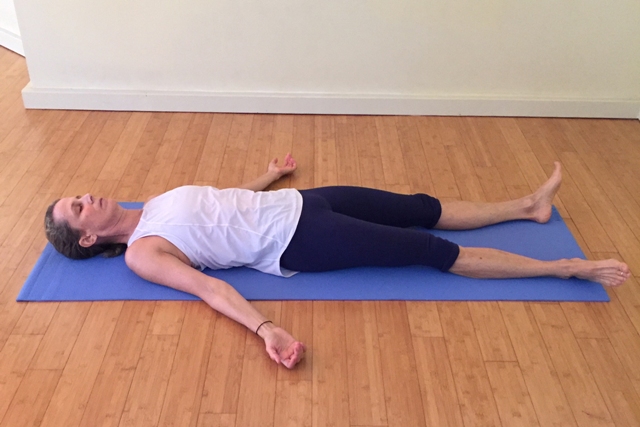
Savasana-Karin-web-large.jpg

The pose of the month for December is Savasana.  That does not mean that we will spend the entire class in Savasana.  Just like every other pose of the month, we will spend maybe 10 or 15 minutes working on the featured pose.   (And, if you are lucky, you will get a lovely Savasana assist by yours truly!)

So what do we need to work on in Savasana?  Aren’t we just supposed to relax and do nothing?  Absolutely, but how many of us can do so?  I know many students who cannot stay for Savasana.  They don’t see the value in “doing nothing”.

But relaxation is so important, it breaks the stress cycle.  We all know how stress is bad for our body and immune system. (You can read about how harmful stress is for your body here.)  While we cannot avoid stress in our lives, we can take steps to promote relaxation and Savasana is one of those ways.

We live in a high stress society.  I am amazed at how many people cannot relax.

All during class I am cueing, cajoling and encouraging my students to engage this, or straighten that, or hug towards the midline, or extend out.  When we finally get to the end, it is time to relax and let go.  Often a strong and sweaty practice is conducive to letting go.  But, I am surprised at how much tension some students can still be holding onto in their bodies during Savasana.

Sometimes during final relaxation, I will go around and adjust a few people. I usually let people know I will be doing this so I don’t startle anyone (and I allow people to opt out).   I approach them quietly and touch them gently before lifting their arm up and slowly wiggling it.  If they are relaxed, the arm should move like the empty sleeve of a jacket.  But more often than not, the arm comes up rigidly and the person moves the arm with me, anticipating which way I am going to wiggle it.  Some students are unconsciously helping me, even though I tell them I don’t want them to help.  It is not unusual for the arm to stay up in the air even after I have let go of it.  When I quietly tell the person that if they were relaxed, the arm would not stay up in the air by itself, they often smile and let the arm down.  Then I begin again.  I ask students to “let go”, to “play dead”, “relax”.  Some people simply cannot do it right away.  It takes practice.  We are so used to being on guard, to protecting ourselves from being taken advantage of, of not allowing ourselves to be vulnerable.  The result is that we cannot let go.

I discovered what I need to do is to prepare people for relaxation; to tell them at the beginning of class what they need to do at the end, to describe what I see and feel in people’s bodies when they are tense.  This seems to help a lot.  In a society that values doing over being, we need instructions on how to relax.

Here are some tips on how to relax:

  1. Plan a place and time to relax (if this is done outside of your regular yoga class.) Showing up is 80% of the work!

  2. Determine the amount of time you have to relax and set a timer. It is easier to relax when you know how much time you are willing to give.

  3. Make yourself comfortable. You should be lying down on the floor.  Place a blanket under you if the floor is hard and you are not on carpet.  Use blankets, bolsters or pillows to support your body in away way to insure you stay comfortable.

  4. Make sure you are warm. As you lay still you will feel cooler than when you were moving, particularly if you were sweaty.  Put on an extra shirt, socks or even cover yourself with a blanket.

  5. Use an eye pillow, if you like, or cover your eyes with something like the sleeve of a shirt or a hand towel. This does two things for you: First, it creates darkness which is more conducive to relaxing.  Second, it weighs the eyes down and helps to keep them from moving around.  (You don’t need something heavy on the eyes, just a gentle suggestion of weight.) Eye movement stimulates the brain and we want the brain to slow down as part of the process of relaxing.

  6. Commit to stillness. Sometimes when I lay down for Savasana I may feel as if I am too fidgety to relax and all of a sudden I have these itches and twitches and urges to move.  90% of the time, if I ignore these urges, they will go away.  It seems that they are the mind’s resistance to staying still.  The mind wants to be stimulated.  If I am able to resist movement I begin to relax.  Now, 10% of the time, you may actually have to scratch that itch, move your leg or grab another pillow.  You have to use common sense here, but don’t be fooled by your restless, monkey mind or you will never be able to relax.

If you don't have the time or inclination to relax at home make sure you come to class during the month of December to work on it.  You’ll be glad you did!

Come on!  I know what you really come to class for:

savasana-t-shirt.jpg

I’ll see you in class!

Karin

Cultivating an Attitude of Gratitude

Several years ago I developed a daily gratitude practice.  I wanted to shift things in my life.  Somehow I knew I had a good life, or even a great life, but I found myself complaining a lot about things. I felt dissatisfied somehow.  I began to see that I was focusing on those things that were going wrong in my life, rather than what was going right.

Back in November 2013, I was waiting in line at the grocery store and I picked up O magazine.   I have always loved Oprah's article called "What I Know for Sure" which is on the last page of the magazine.   In this particular article she wrote about how much her gratitude practice helped her.  I remember thinking that Oprah, who seemed to have everything, had to practice being grateful???  But she did.  And, so, I thought that if it was good enough for her, then maybe I should give it a try.

I keep a journal by my bedside and write in it every night 5 things I am grateful for.  That was the beginning in a big shift in my attitude.  Sometimes I am grateful for the same things every night: my husband, my son, my house.  Sometimes I am grateful for the simplest things:  my car starts every morning when I turn the key, I have hot water, I don't have a tooth ache.  The act of being grateful points the way to other things that I am grateful for and so my life changes from feeling somewhat vaguely discontented to realizing how wonderful my life truly is!

29gifts.jpg

One of the things I am enormously grateful for is my job.  I love teaching yoga and I love my students.  In one of my teacher training sessions, one of my students, who also shared a love of Oprah, shared a book with me:  29 Gifts by Cami Walker.

Here is the description of the book from Amazon:

"At age thirty-five, Cami Walker was burdened by an intensified struggle with multiple sclerosis, a chronic neurological disease that left her debilitated and depressed. Then she received an uncommon “prescription” from South African healer Mbali Creazzo: Give away 29 gifts in 29 days.

29 Gifts is the insightful story of the author's life change as she embraces and reflects on the naturally reciprocal process of giving. Many of Walker's gifts were simple—a phone call, spare change, a Kleenex. Yet the acts were transformative. By Day 29, not only had Walker's health and happiness improved, but she had created a worldwide giving movement. 29 Gifts shows how a simple, daily practice of altruism can dramatically alter your outlook on the world."

Check out the 29 gifts website here.

The book details the "prescription" given to Cami by Mbali Creazzo which I wrote about here.

I know that Thanksgiving is the time of the year that we are already supposed to be be thankful.  So, I thought it would be a good idea to take this time to cultivate an "Attitude of Gratitude" that lasted for more than one day.  You might feel that with the beginning of the holiday season that you are already worried about what you are "getting" other people.  But I encourage you to think about these gifts differently.  A gift could be: a compliment, a hug, giving somebody something you already have (but maybe don't use) that you know they would want.


Mbali writes about how the prescription of giving for 29 days changed her life.  She says:  "When I am in service to another person, I am moving from a place of self-centeredness to selflessness.  The act of giving inherently carries gratitude in it.  For me, it is impossible to give without feeling grateful."

Maybe the timing is not quite right for you to begin giving 29 gifts right now.  If it isn't,  wait until you have read the book.  Maybe you start in the new year, as I did on January 4th of last year.  If you do this practice, I guarantee it will cause a shift in your perspective and may very well change your life.

I leave you with my favorite quote about gratitude.  I read this every Thanksgiving to my classes and at my own Thanksgiving dinner table:

Gratitude unlocks the fullness of life. It turns what we have into enough, and more. It turns denial into acceptance, chaos to order, confusion to clarity. It can turn a meal into a feast, a house into a home, a stranger into a friend. Gratitude makes sense of our past, brings peace for today, and creates a vision for tomorrow.” - Melody Beattie

If you embark on this mission, please share your experiences below.  May you have a wonderful holiday filled with gratitude for all the blessings in your life!

Namaste,

Karin


What is up with "Venting"?

The Five Layers of the Body

The Five Layers of the Body

My intention as a yoga teacher is to teach "alignment based yoga".  Maybe that sounds obvious, after all who would teach yoga in a non-aligned way?  That would just be unsafe.  Proper physical alignment in postures is important to stretching and strengthening safely.  But physically aligned poses just touch one layer of our being.

Annamaya Kosha:  The physical, or food layer.  This layer contains our muscles, bones and organs.  This is the physical level of doing postures "correctly".
Pranamaya Kosha:  The energetic level.  This is the level of our breath, our energy, our spirit.  We do Pranayama, or breath work, to access this layer.
Manomaya Kosha: The mental layer.  This is the level of our senses, awareness and perception of things.  This is where we experience the postures and the effects they have on us.
Vijnamaya Kosha:  The intellectual layer.  This layer contains our ability to discern, to discriminate. This is where we are concerned with what is behind the postures.
Anandamaya Kosha: The bliss layer.  This is where we recognize our connection to something greater than ourselves.

There is more to yoga than just doing postures correctly; it has to do with how we perceive and act in our world, it also has to do with the quality of our health and energy and our interactions with others.  Our yoga practice really begins the moment we step off our mat.

In my Yoga Teacher Training Program we talk about the Yamas and the Niyamas; the ethical precepts of yoga.  The first one is ahimsa, or non-violence and the second one is satya, or truthfulness.  Recently a student had this question:  “I was thinking about the yamas and niyamas, about ahimsa and satya- and I'm wondering does complaining or 'venting' fall into either of these categories? I often vent to my boyfriend about people in my life (like my friends or my mom) if I get frustrated with them or annoyed at something they did or said. I don't think this is gossiping, because I am just venting my frustrations, but I feel like it is something! I'm just not sure which yama it would fall under.”

Venting is something we all do and while it sometimes feels good to get things off your chest, it also doesn’t feel good.  As the student comments, “…it is something!”

There are several reasons why it is “something”.

The First Two Yamas: Ahimsa and Satya

The yamas are considered restraints.  As I mentioned above, we have only talked about ahimsa and satya so far.  So I will only look at these two; although the yamas and niyamas are meant to be looked at in relationship to each other because they are truly intertwined.  Is venting your frustrations harmful to another?  Maybe not if the person about whom you are talking doesn’t hear it.  But what if they did?  They might not like what you said about them.  Would what you said be harmful?  If the answer is “yes”, then you know that you are not in alignment with ahimsa.  In terms of satya, or truthfulness is what you said true?  Or, is it just your opinion?  While you may not like what your friend or mother did, that is your opinion.  You don’t know why they acted the way they did.  People do things for their own reasons.  More about his under The Four Agreements later.

The Laws of Karma

The real question to ask is how does venting harm you?   This is where the laws of karma come in.  Karma is defined as anything you think, do or say.  Thoughts and words plant seeds as much as actions do. One of the reasons it feels like “something” when you vent about others is that it is planting negative seeds.  Planting seeds of gossiping or complaining causes those things to happen to you.  Just like planting a tomato seed will only produce tomatoes and not pumpkins. Have you ever been hurt by what others have said about you?  The best cure for that is to not say things about others.  This is a challenging but extremely rewarding practice.  I think it is human nature to vent our frustrations, but nothing good ever comes out of it.  While I initially think I will feel better when I get it off of my chest, I almost always feel a little cheap or dirty, a little something, afterwards.  In other words, I don’t feel good about it.

The Four Agreements

While these agreements come from a different discipline, I think they are applicable here.

  1. Be Impeccable with your Word:Speak with integrity. Say only what you mean. Avoid using the Word to speak against yourself or to gossip about others. Use the power of your Word in the direction of truth and love.

  2. Don’t Take Anything Personally
    Nothing others do is because of you. What others say and do is a projection of their own reality, their own dream. When you are immune to the opinions and actions of others, you won’t be the victim of needless suffering.

  3. Don’t Make Assumptions
    Find the courage to ask questions and to express what you really want. Communicate with others as clearly as you can to avoid misunderstandings, sadness and drama. With just this one agreement, you can completely transform your life.

  4. Always Do Your Best
    Your best is going to change from moment to moment; it will be different when you are healthy as opposed to sick. Under any circumstance, simply do your best, and you will avoid self-judgment, self-abuse, and regret. 

Again, I will refer to the first two only.  (What a coincidence!)  Venting falls under the category of Being Impeccable with your Word which relates to satya.  This one is simple; venting is not using your word in the direction of truth and love.  In my study of yoga philosophy I have learned that the ancient seers believed that the universe was created by sound.  Even in the Bible, Genesis starts with: “In the beginning was the Word, and the Word was with God and the Word was God.” In yoga there is this idea that the sound “AUM” is the sound of creation.  Scientists have discovered that there is a sound, a vibration in the universe that corresponds to the sound of AUM.  We have all heard that we have the power to create our world with our words, or to destroy someone else’s. In order to manifest things in our lives we often have to speak them out loud.  What do we want to create? What are we creating with our words either consciously or unconsciously?  Again, since karma is everything you think, do or say we need to pay more attention to our thoughts, actions and speech.  There is an interesting story I heard about our thought patterns:

A man was looking to relocate his family in a new town.  He decided to take a drive one day to check out the town he wanted to move into.  He stopped at a gas station to fill his tank and he asked the attendant what the people were like who lived in this town.  The gas station attendant was very wise and asked the motorist what the people who lived in his town were like.  The man said that the people in his town were very nice, hard-working, trustworthy and always ready to lend a hand to someone in need.  The gas station attendant said, “Well, I guess you will find people to be the same around here.”  The man thanked him and drove off.   On another day another man was looking to relocate to this same town.  He pulled into the gas station and asked the attendant what the people were like who lived in this town.  The attendant asked what the people who lived in his town were like.  The man said he hated the people in his town and that was why he was looking to move away.  He said the people were mean and he didn’t trust his neighbors.  The gas station attendant said, “Well, I guess you will find people to be the same around here.”

The Divine Truth of the Seventh Chakra

According to medical intuitive, Caroline Myss, the “Divine Truth” of the seventh chakra is to “Live in the present moment”.  The last reason I can think of as to why venting is “something” is the idea that we are usually venting about something that has already happened.  Another story: 

Monks take a vow of celibacy and are not supposed to have contact with women.  Once, long, long ago, two monks were walking along a path.  They came upon a finely dressed women who asked the monks if they could carry her across the stream as there was no bridge or other way to get across without ruining her dress. The younger monk felt very uncomfortable about touching the woman and declined.  The older monk picked up the woman, carried her across the stream and set her down safely on the other side.

The two monks walked along for a little while in silence.  Finally the younger monk asked the older monk how he felt about breaking his vow and touching a woman.  The older monk looked at the younger monk and said, “Brother, I put that woman down a half an hour ago.  Why are you still carrying her around?”

We cannot control our friends or our parents.  And we know that people do things for their own reasons.  How much of our energy are we tying up by living in the past and complaining about what someone did previously?  Can we learn to unplug, to let go and to bring all of our energy into the present moment?  Better yet, can we learn to bless our friends, neighbors, parents or kids as they move along on their journey while we attend to ours?  Think of how much more energy we will have for ourselves and our own affairs if we let go of the affairs of others.

Simple but not easy!

Metta Meditation – May all beings be happy and free. 

279-Karen-Eisen-Yoga-Padmasana-square-web-large.jpg

Metta meditation, or loving kindness meditation, is the practice concerned with the cultivation of benevolence or kindness.  The practice consists of silent repetitions of phrases like “may you be happy” or “may you be free from suffering”.  These feelings are directed initially towards oneself, then a loved one, a neutral person and finally a difficult person.

This particular meditation is directed towards freeing the person doing the meditating from the negative thoughts associated with holding grudges or ill-will against another being.  Holding a grudge against someone, or being angry with someone is a lot like “drinking poison and hoping the other person dies”.  The only person being harmed is the person holding the negative emotion.  The other person may be totally oblivious to your feelings about them.

To start, come to a comfortable sitting position with the spine erect.  Take a nice deep inhale followed by a couple of long slow exhale.  Do this a few times until you no longer feel any power behind the letting go of the breath.  Imagine the love and light of Divine Consciousness (your idea of God or the wisdom of your own heart) pouring over you and washing through you, revealing the purity of your own heart.  Feel yourself totally safe, loved and enclosed in this radiant light.  Repeat these lovingkindness blessings to yourself:

May I be at peace, May my heart remain open
May I awaken to the light of my own true nature,
May I be healed, May I be a source of healing for all beings.

The second step of Metta extends blessing to our loved ones.  Bring a loved one to mind.  See them in as much detail as possible.  Imagine the light of Divine Consciousness pouring over them and revealing the purity of their own heart.  Imagine them totally safe, loved and enclosed in this radiant light.  Then bless them:

 May you be at peace, May your heart remain open
May you awaken to the light of your own true nature,
May you be healed, May you be a source of healing for all beings.

The third step of Metta extends blessings to a neutral person.  Someone you may come into contact with in your day, but you don’t really know; like the cashier at the grocery store.  Bring this person to mind.  See them in as much detail as possible.  Imagine the light of Divine Consciousness pouring over them and revealing the purity of their own heart.  Imagine them totally safe, loved and enclosed in this radiant light.  Then bless them: 

May you be at peace, May your heart remain open
May you awaken to the light of your own true nature,
May you be healed, May you be a source of healing for all beings.

A fourth step of Metta extends blessings to someone who may be a little bit or a lot hard to love.  Start with someone who is just a little hard to love.  It is quite an advanced practice to send Lovingkindness to someone with whom you have great difficulty.  But remember, this practice is as much for yourself as it is for someone else!  Bring this person to mind.  See them in as much detail as possible.  Imagine the light of Divine Consciousness pouring over them and revealing the purity of their own heart.  Try to remember that they are just trying to do the best they can with where they are on the path.   Imagine them totally safe, loved and enclosed in this radiant light.  Imagine this light washing away all of their negativity and illusion.  Then bless them:

May you be at peace, May your heart remain open
May you awaken to the light of your own true nature,
May you be healed, May you be a source of healing for all beings.

Notice how these practices affect your own heart.  Do you feel more open?  Do you feel more of a sense of lovingkindness?  If judgmental thoughts about others occur during the day, take a moment to send lovingkindness blessings first to yourself and then to them.

The chant that I have been doing in class is a lovingkindness chant.  Use it to help ground you in a sense of compassion and lovingkindness:

Lokah Samastha Sukhino Bhavantu

Listen to Russil Paul's version of this chant here.

Which is poetically translated as:

May all beings have happiness and the causes of happiness.
May all beings be free from suffering and the causes of suffering.
May all beings never be parted from freedom’s true joy.
May all beings rest in equanimity free from attachment and aversion.

Metta meditation - May all beings be happy and free.  Not just me and the people I love, but all beings, even the ones I may have difficulty with!  (gulp!)

The Eight Steps to a Yogic Lifestyle - Step # 1 - Ahimsa or Non-Violence

Sometimes the stages or steps of yoga are described as a ladder; you progress in an orderly fashion from one stage to the next. At other times the stages of yoga are described as spokes of a wheel that radiate in toward a center. In either case, the point is to be working toward a more highly evolved state, or Samadhi. In reality, the stages tend to overlap each other and lack of progress in one stage may send you back to one of the other stages looking for answers.
For instance, say you want to work on meditation, but you have a hard time sitting still; you can’t get comfortable, you have difficulty concentrating and you find your mind filled with thoughts of anger. If you have trouble sitting, maybe you need to look at the third step on the path: asana. Perhaps doing more asana would help you open your hips to sit more comfortably, or learning how to prop yourself into a more comfortable positions would be a good idea. If you have difficulty concentrating (Dharana) it might be because you feel strongly pulled by your senses (Pratyhara) and have trouble closing your eyes and turning your attention inward. You might need to go back one step and look at where your attention is being pulled to. Or, especially if you are struggling with negative emotions like anger, you would have to go all of the way back to the Yamas and the Niyamas and see where you are being tripped up by not observing moral restraints (Yama) or your personal observances (Niyama).

In one of her contemplation articles, Swami Nirmalanda talks about this:
"You are the light of consciousness, manifested in a unique and individualized form. That light shines through your eyes, fills your heart and sparks your greatest ideas. The light of your own being arises from its source, spills into your life and fills your relationships with light and love and joy.

This happens consistently and reliably only when you have cleared the pathway. The pathway for the light of consciousness is your mind. This means you must do some yogic work on your mind, not just yoga for your body and breath. I would like to make two related points here: 1) working on your body is not enough; 2) when you work on your body, more begins to open up.

Working on Your Body Is Not Enough
Perhaps you expect your yoga practice to perfect your body. If so, is this a reasonable prediction of your future? I know many yogis who have been practicing for decades. This means they are now decades older than when they began. While their aging process is profoundly different than any non-yogi, none of them expect their body to return to the condition it was in when they were 15 or 25 years old (assuming it was perfect back then).

Still, if your goal is to perfect your body, does that mean you will shine with the light of consciousness when your body is perfect? If so, the fashion models, TV & movie stars, professional athletes and singer-dancers would be enlightened. This is clearly not the case!

Thus working on your body is not enough. You must begin aligning your life with the principles of light by following yoga’s precepts for living, so your own inner radiance can shine through your life. Yoga’s precepts for living are titled the Yamas and Niyamas. There are five of each, which we’ll explore in next few months."

The Eight Stages of Yoga are:
Yama – moral restraints. There are five of these: Ahimsa (non-violence), Satya (truthfulness), Asteya (non-stealing), Brahmacarya (restraint), Aparigraha (non-hoarding)
Niyama – observances. There are five of these: Saucha (cleanliness), Santosha (contentment), Tapas (effort), Svadhyaya (study), Ishvara Pranidhana (surrender to something greater than yourself).
Asana – physical postures
Pranayama – breath work
Pratyhara – withdrawal of the senses
Dharana - concentration
Dhyana - meditation
Samadhi – enlightenment

In my teacher training, I talk about the stages of yoga in a ladder form. We always start with the first Yama, which is Ahimsa. The Sanskrit word Himsa means violence. Whenever you put an “a” in front of a word, it means “not that”. So, Ahimsa means non-violence. I think most of us would describe ourselves as non-violent. And I hope that is true. We don’t go around killing each other, or even hitting each other. I remember when I adopted my son I had to sign an agreement with the adoption agency that I would not use corporal punishment as a means of disciplining my child. Maybe because my parents used to hit me, I had no intention of ever hitting my child, but still, signing the form was interesting and reinforced my practice of ahimsa.
But is outward violence the only form of violence? I like to think of these practices as having layers or a series of concentric circles; you can get closer to the core, or you can be working out on the periphery. You may not act out in a violent way, but do you have murderous thoughts? Have you ever said to your kid (not meaning it literally) “If you get mud on my clean floor again, I’m going to kill you”? Of course you aren’t going to kill your kid, but what does the choice of language do to our psyche? How angry are we? Sometimes students will ask what the difference is if I think these thoughts but I never act on them; nobody will know but me. And I would say to them, but, you will know. Why are you so unimportant that you are willing to harbor those thoughts? This is your mind, your conscience, your soul that you are talking about. Inside of your head, you are the only one who matters. This is a deep level of integrity to practice non-violence at this level. It is also you alone who sits on your meditation cushion and practices turning inward. If you have even these seemingly innocuous thoughts of violence in there, is the inside of your head a comfortable place to be?

Peace and Ahimsa
In her book Practicing Peace in times of War, Pema Chodron, an American Buddhist nun, talks about how to cultivate peace. She says:

War and Peace start in the hearts of individuals. Strangely enough, even though all beings would like to live in peace, our method for obtaining peace over the generations seems not to be very effective: we seek peace and happiness by going to war. This can occur at the level of our domestic situation, in our relationships with those close to us. Maybe we come home from work and we’re tired and we just want some peace; but at home all hell is breaking loose for one reason or another, and so we start yelling at people. What is our motivation? We want some happiness and ease and peace, but what we do is get even more worked up and we get everyone else worked up, too. This is a familiar scenario in our homes, our workplaces, in our communities, even when we are just driving our cars. We’re just driving along and someone cuts in front of us and then what? Well, we don’t like it, so we roll down the window and scream at them.”

“War begins when we harden our hearts, and we harden them easily – in minor ways and then in quite serious, major ways, such as hatred and prejudice – whenever we feel uncomfortable. It’s so sad, really, because our motivation in hardening our hearts is to find some kind of ease, some freedom from the distress that we’re feeling.”
“Someone once gave me a poem with a line in it that offers a good definition of peace: “Softening what is rigid in our hearts.” We can talk about ending war, we can do everything in our power, but war is never going to end as long as our hearts are hardened against each other.

In the Yoga Sutras, Patanjali gives us a way to measure our practice of Ahimsa:

Ahimsaa-pratishthaayaam tat-samnidhau vaira-tyaagah. Patanjali Y.S. 2.35
All others will cease to feel hostility in the presence of one who is firmly established in ahimsa.

If you are firmly established in the practice of non-violence, others will cease to be violent in your presence. This means that you don’t feel hostility towards anyone. It even means that you don’t think harmful thoughts towards anyone. Not only do you refrain from hitting someone, you even refrain from yelling at them or from making snide or sarcastic remarks. (Yes, to that deep a level!) But, as human beings we have violent impulses. What do we do when they arise? First, we acknowledge these feelings or impulses. Second, we wait with them. Remember the old count to ten technique? Do it! Breathe. Wait it out. If you truly practice this, the violent urge or impulse will fade and eventually disappear.

Again, Swami Nirmalanda says:
"This is not suppression, denial or avoidance. You’ve already tried these strategies and know that they don’t work. Now you’re taking the intelligent path: simply don’t hurt others. You’re only tempted to hurt them because you’re not getting your own way. But don’t take it out on them. Even if they could improve the situation, hurting them is not the most effective way to make progress. Thus intelligence demands that you don’t act on your harm-causing impulses, even though they will continue to arise inside for some time. It takes time to eradicate your own violent tendencies.

You have violent impulses because you are a human being. It is a human characteristic. Everyone feels this way sometimes, until they’ve used yoga to become free. You will feel like hurting someone but, since you’re a yogi, you are simply not going to do it. What do you do instead? Simply feel it. Feel the violent impulse. Don’t deny that you feel like killing that person, but don’t kill them. The yogic key is this: you must be aware that you feel like killing them. Let the feeling arise; don’t even put words to it. Just feel it, and while you are feeling it, don’t act on it.

If you let it arise, and you don’t lie to yourself about the feeling, it will only last a short time. It might last 45 seconds, or it might last 3 minutes. But it won’t last long. If it lasts longer, you weren’t actually allowing yourself to feel it; you were trying to justify it, or trying to figure out what to do about it. Just feel it. It dissolves, like fog in sunlight.

That is exactly what it is, brain-fog. It is the clouds of confusion, the mists of delusion, and the fog of dependency mucking up your innards. When you go outside and stand in the fog, which I love to do especially at sunrise, the sun comes up and shines through the fog. Slowly the fog dissipates. It melts away.

You must do the same thing with your brain-fog. Stand in the fog, being aware of the fog. Your awareness is the sunlight. It is the light of consciousness, and it dissolves the fog. It dissolves your anger and fear; it dissolves your desire, need and greed; it dissolves your regret and worry; it dissolves your blame and guilt. It dissolves all the reasons you want to hurt someone or something."

Discussing Ahimsa is very interesting. As you can see, it is not just outward violence that we are talking about, it is subtle violence. It can be found in thoughts inside our heads or in snide or sarcastic remarks. Have you ever made a snarky remark to someone where you thought you were being funny and that other person just didn’t take it that way? (Has that only happened to me???)

The beautiful thing about the Yoga Sutras is that all it says is “non-violence”. It is up to us to think about it, tease it apart and understand it on any and all levels. It is up to us to examine and question ourselves. I like to ask my yoga teacher trainees this question.  They are always surprised when I ask it.  o, let me leave you with this question to think about: “Is texting and act of violence?”

What do you think? Leave an answer in the comments below.