


Parivrtta Parsva Konasana or Revolved Side Angle Pose is a deep twist. Even though it looks like Side Angle it is more related to Warrior I because of the orientation of the hips.
Parivrtta means revolved, turned round or back.
Parsva means side or flank.
Kona is an angle.

This is revolved side angle pose. It is a deep twisting posture that forms the foundation of many other twisting poses such as Parsva Bakasana, Side Crow and Eka Pada Koundinyasana I, a twisting arm balance. As we play with this pose this month, we will see where it leads us.
Parivrtta Parsva Konasana looks like Side Angle Pose with a twist, however, it is more related to Warrior I as the hips are facing the front leg, rather than turned open. It is a harder twist than Revolved Triangle Pose because of the position of the bent knee. The bent knee locks the hips in and restricts the twisting action in the lower back. In Revolved Triangle Pose, the twist is more evenly spread over the length of the spine. It is for this reason that Revolved Side Angle Pose can be therapeutic for the low back. But, it is also a caution to allow the spine to twist organically and not to try to force the twist. We will use other more open twists to prepare the body to come into Revolved Side Angle Pose.
The nature of twisting poses is that they change energy. If you are feeling stuck and lethargic, twists can help you get unstuck and energize you. On the other hand if you’re feeling wound up, twists can release energy and calm you down.
The thing about twists, however, is that when we run into difficulty in this pose we literally run into our self. Our own body gets in our way. How do we sit with the energy of that? What does it bring up for us? Does the judge or critic show up? Do we get mad or frustrated with ourselves? Do we try to use our arms for leverage and try to force ourselves into some external, or preconceived idea about ourselves? This is the interesting, inner work of the pose.
Pay attention to your breath while practicing Parivrtta Parsva Konasana. We generally use an exhalation to come into a twist and an inhalation to come out. Once you are in the pose notice your breath. It will be a little more restricted , but can you still breathe easily?
The time between Thanksgiving and New Year’s are so jam packed and busy, I often feel compelled to teach restorative poses just so people can have a few minutes of relaxation. That doesn’t mean that the entire class will be restorative, it just means that we might start or end with a restorative pose or two. In the middle, I plan on reviewing the poses that we went over this year. Here they are in the order in which we did them:
January – Sarvangasana or Shoulder Stand

Read about Shoulder Stand here.
February – Sirsasana I or Head Stand on forearms

Read about Head Stand here.
March – Navasana or Boat Pose

Read about Boat Pose here.
April – Bakasana or Crow

Read about Crow Pose here.
May – Svarga Dvijasana or Bird of Paradise

Read about Bird of Paradise here.
June – Hanumanasana or Split

Read about Split here.
July – Parivrtta Parsva Konasana or Revolved Side Angle Pose
Read about Revolved Side Angle Pose here.
August- Visvamitrasana or Side Plank with lower leg lifted

Read about Visvamitrasana here.
September – Urdhva Dhanurasana or Wheel

Read about Wheel here.
October – Prasarita Padottanasana to Sirsasana II or Wide Leg Forward Fold to Tripod Head Stand


Read about the transition from Wide Legged Forward Fold to Headstand here.
November – Astavakrasana or Eight Crooked Places Pose
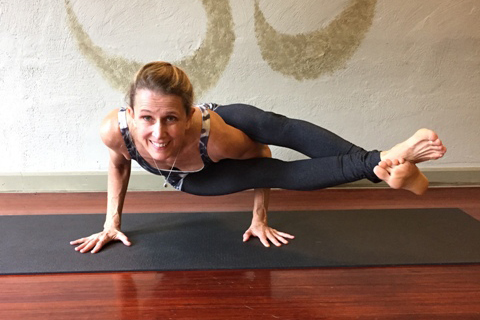
Read about Astavakrasana here.
December – I hope you enjoy this year in review! Also, if you have any requests for poses that you would like to work on next year, let me know in the comments below.
Continuing with postures in the sequence for Astavakrasana, let’s look at Lizard Lunge.
In order to be able to do Astavakrasana you have to be able to get your knee onto the back of your arm when you are in a seated position. In Lizard Lunge, you can see whether or not your shoulder is below your knee.
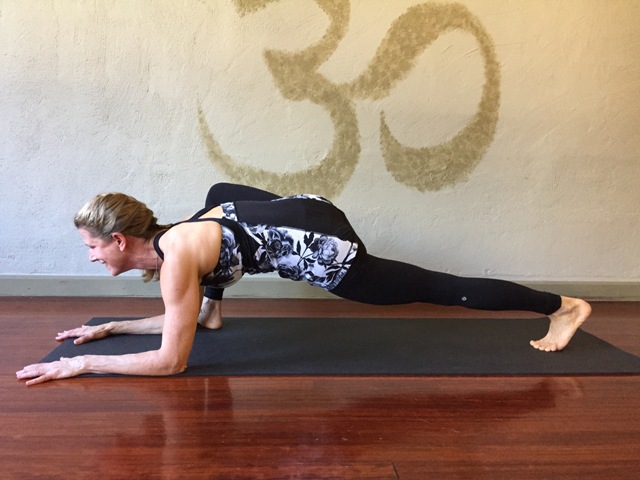
In this pose, the back leg is straight and the front leg bent with the shin perpendicular to the floor. If you can easily get both forearms evenly on the ground, then chances are that you have the flexibility to do Astavakrasana.
In the beginning you start with your hands on the floor,

eventually lowering your elbows to blocks and finally to the floor. It is harder to lower the inside elbow to the floor.
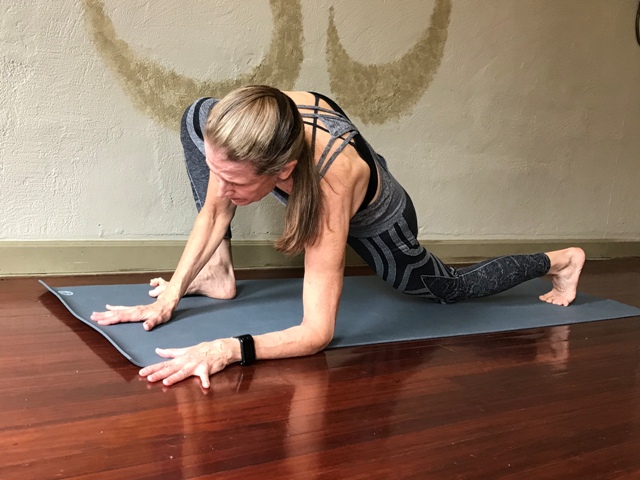
It is important to lower them both evenly. You may have to back up until you are able to achieve this. This may take a while. If you are interested in doing Astavakrasana, you might want to practice Lizard Lunge every day until you can easily get your elbows to the floor. This practice could unlock other poses for you as well such as Warrior I, Pigeon and Split.
In some of these photos, you can see that my back knee is on the floor. In the beginning, you might need to bend your back leg. Eventually, you may be able to keep the knee lifted and the back leg straight.
It is also important to maintain the length on the front body. Your torso will round if you are reaching too hard to get the elbows to the floor. Keep pressing down into the hands or forearms and lengthen your collar bones forward. Draw your shoulder blades towards each other and down your back towards your waist rather than away from each other and down towards the floor. As you would in Caturanga, don’t drop your head. Keep your neck in line with the spine and the back of your head level with your upper back.
You may be tempted to let the front ankle roll out. Some call this “Broken Pigeon”.

This often happens in the desire to get the elbows to the floor. This could be a good variation when you are working towards poses with the legs externally rotated such as Pigeon or Seated Cobbler’s Pose. But for now we are working on our ability to fold forward with one knee bent into our chest as in Marichyasana I.

For this pose, I prefer keeping the weight pressing down onto the inner edge of the foot and keeping the ankle straight. If you need some play, it is better to let the knee and foot rotate out a few degrees, but I would only do this if I could not get my hands to the floor, not to get my elbows to the floor. Be patient. Don’t force the stretch.

The next step would be to come into Eka Hasta Bhujasana, or One Arm Leg Pressure Pose.

And from there into Astavakrasana

Continuing with postures in the sequence for Astavakrasana, let’s look at Lizard Lunge.In order to be able to do Astavakrasana you have to be able to get your knee onto the back of your arm when you are in a seated position. In Lizard Lunge, you can see whether or not your shoulder is below your knee. In this pose, the back leg is straight and the front leg bent with the shin perpendicular to the floor. If you can easily get both forearms evenly on the ground, then chances are that you have the flexibility to do Astavakrasana.In the beginning you start with your hands on the floor, eventually lowering your elbows to blocks and finally to the floor. It is harder to lower the inside elbow to the floor. It is important to lower them both evenly. You may have to back up until you are able to achieve this. This may take a while. If you are interested in doing Astavakrasana, you might want to practice Lizard Lunge every day until you can easily get your elbows to the floor. This practice could unlock other poses for you as well such as Warrior I, Pigeon and Split. In some of these photos, you can see that my back knee is on the floor. In the beginning, you might need to bend your back leg. Eventually, you may be able to keep the knee lifted and the back leg straight. It is also important to maintain the length on the front body. Your torso will round if you are reaching too hard to get the elbows to the floor. Keep pressing down into the hands or forearms and lengthen your collar bones forward. Draw your shoulder blades towards each other and down your back towards your waist rather than away from each other and down towards the floor. As you would in Caturanga, don’t drop your head. Keep your neck in line with the spine and the back of your head level with your upper back.You may be tempted to let the front ankle roll out. Some call this “Broken Pigeon”.This often happens in the desire to get the elbows to the floor. This could be a good variation when you are working towards poses with the legs externally rotated such as Pigeon or Seated Cobbler’s Pose. But for now we are working on our ability to fold forward with one knee bent into our chest as in Marichyasana I.For this pose, I prefer keeping the weight pressing down onto the inner edge of the foot and keeping the ankle straight. If you need some play, it is better to let the knee and foot rotate out a few degrees, but I would only do this if I could not get my hands to the floor, not to get my elbows to the floor. Be patient. Don’t force the stretch.The next step would be to come into Eka Hasta Bhujasana, or One Arm Leg Pressure Pose. And from there into Astavakrasana
Why you should never do Side Angle Pose with your elbow on your knee.
I am not a fan of doing Side Angle Pose with your elbow on your knee. I prefer putting your hand on the floor or on a block. There are always exceptions and I understand that for some people that may be the best variation.

See how the lower shoulder is collapsed as I rest my weight into that elbow instead of lifting up off it?
However, the primary reason I don’t recommend the bent elbow version of this pose is because when students put their elbow on their knee in Side Angle, there is a tendency to collapse into that bottom shoulder.
They can be made aware of that and they can learn to press their elbow into their knee and open the chest and collar bone on that lower side, but that action is often not taught. It is much more natural to press down into the bottom hand when it is on the floor or on a block. But still, that action of opening the bottom chest needs to be demonstrated and taught.

If you are doing a gentle yoga class and you are just moving through some basic poses, then there might not be a reason to go any deeper into Side Angle Pose than elbow to knee. But if you are doing a more progressive form of yoga where poses build on each other, then it is important to see and use Side Angle Pose as a gateway to more complex asanas.
Let’s take Astavakrasana, for example. In order to be able to approach this arm balance, you will need to develop the flexibility to get your shoulder under your bent knee. The entry into Astavakrasana comes from a pose called Eka Hasta Bhujasana which looks like this:
Eka Hasta Bhujasana, which means One Arm Leg Press Pose. You can see that I have to hook one of my legs over my shoulder.
This work begins in Side Angle pose where we work to get the bottom hand to the floor outside of the bent knee.

Notice the relationship of the knee and the shoulder. This is considered the full pose with the bottom hand on the floor.

When you take your hand to the floor, make sure that you do not allow your front thigh to drop below horizontal. Keep from doing this by pressing down on the outer edge of the back foot and lifting the inner back thigh away from the floor.
In the beginning, your hand may be on the tall side of a block, which is about the same height you would be in if you had your elbow on your knee.

Compare the height of the shoulder to the knee in this version of the pose with the picture of me with my elbow on my knee below. They appear to be practically at the same height. If the elbow rests on the knee, there is too big of a change to go from there to hand on the floor. But with your hand on the tall block, it is a gradual process of stretching to get the hand to the middle level of the block, to the lower level of the block and to finally getting the hand to the floor.
Performing this pose by placing the elbow on the knee prevents you from exploring your capacity to go deeper over time. This is a modification of Side Angle Pose. It is not the full pose.
But over time, you lower the block to its medium height and then to its lowest height until you can finally you put the hand on the floor.

The shoulder is getting lower as the flexibility in the hip increases.
If you look at the relationship of the shoulder and the knee full Side Angle Pose, you can see that they get very close together when you can get your hand to the floor.

The shoulder is getting even close to the knee.

No matter what stage you find yourself in Side Angle Pose remember to maintain the geometry of a straight line form back foot to top hand, front thigh parallel to the floor and front shin perpendicular to the floor.
If you are looking to improve your flexibility and range of motion then you can see why you would want to work towards the full version of Side Angle Pose. It is this flexibility that is necessary to do poses like Astavakrasana.

Astavakrasana, or Eight Crooked Places Pose.
Other postures that build on the flexibility of Side Angle Pose include: binding in Side Angle Pose, Bird of Paradise, Lizard Lunge, Revolved Side Angle Pose, Crow, Tortoise, Seated Wide Leg Forward Fold, Revolved Seated Tree and probably others that aren’t coming to mind right now.
The transition from one pose to another requires the ability to do the two postures individually. It is also important to understand how the actions of one pose are developed and then get carried on to the next. There is a progression in learning yoga poses.
Wide Legged Forward Fold is typically learned beforeinversions because it gets the head lower than the heart preparing the body forinverting. The placement of the head andhands in Prasarita Padottanasana sets the foundation for Headstand II. A couple of important points in this standingpose are the straightness of the legs due to the engagement of the quadricepsand the ability to hinge at the hips and elongate the trunk to get the top ofthe head towards the floor.
The Straightness of the Legs.
This is often a point of confusion for students who havebeen taught to soften their knees in standing poses. This may be a good cue for gentle yogaclasses where the aim is to breathe and move and where the poses are notbuilding upon each other but are done for their own sake. But, if you are interested in a progressivepractice that teaches you to do more complex poses, then the basics need to belearned. In straight leg poses the legsare meant to be straight, which is not locked out and hyper-extended – that isa different problem! In order tostraighten the legs, the quadriceps muscles need to be engaged which in turndraws the knee caps up into the thigh. You can tell if your quads are engaged if, when you grab your knee capwith your fingers, you cannot wiggle it from side to side.
If you look at my legs in Prasarita Padottanasana,

Wide-Legged Forward Fold
in the Wide Legged transition between the Forward Fold and Headstand,

and then in Sirsasana II itself,

there is never a point where my legs are bent, or my knees are “soft”. This engagement of the legs does two things: it allows me to bend and hinge only at the hip joint and not at the knees and low back, and it keeps my awareness focused on balancing my body parts by knowing where they are and what they are doing in space. And it allows me to balance!
Try this: Find abroomstick or a yardstick, dowel or even a baseball bat and place it on yourpalm or the finger tip of one hand and, without gripping it with your fingers,see if you can balance it. Chances arethat you will be able to, at least for a little while. Now, imagine that the thing you are balancinghad a joint in the middle that was soft and wiggly. Would you still be able to balance thestick? The answer is no, because the toppart would fall in the direction of the bend and you would have no control overit. Engaging your muscles is exertingcontrol over your body.
Check out this handstand video clip. Notice how straight her arms and legs arefrom the forward fold into the handstand. There is only a slight bend in the leg she uses to hop up: https://www.pinterest.com/pin/119908408816084757/
So the first skill we will work on this month is tostraighten and strengthen the legs. Wewill work on this in Triangle, Pyramid Pose, Warrior III, Half Moon Pose andStanding Hand to Big Toe Pose.
Next week we will work on Tripod Headstand. Then, before you learn to lift from Wide Legged Forward Fold into Tripod Headstand, you will learn to come down from Tripod Headstand into Wide Legged Forward Fold. First we will do this one leg at a time, without falling out and then with both legs at the same time. After that, you will be ready to learn to lift up from Prasarita Padottanasana into Sirsasana II.
Urdhva means upwardfacing and Dhanurasana means bow. That would make this pose Upward Facing Bow Pose. However, it is more commonly called Wheel (even though the Sanskrit word for wheel is Chakra – go figure). Regardless of what we call this pose, it is a big back bend.

To prepare for Urdhva Dhanurasana we need to open our shoulders, upper back, front of the hips and front of the thighs. If these parts of the body aren’t open enough, we might feel pain in our low backs, wrists or neck. The hips and shoulders are the most moveable parts of the body. But, if they don't have their optimum range of movement, then the wrists, elbows, neck, knees, ankles and low back can take the strain because they are often asked to move more than they should.
Often students will ask me how they can stretch their wrists because that’s where they feel the most pain when they do Wheel. Often the site of the pain is not the cause of the pain and this is true with the wrists in Wheel. If you are feeling pain in your wrists during Wheel, or other poses where the hands are part of the foundation, the reason for the pain is most likely because of restricted movement in your shoulders.
This month, we will explore opening your shoulders, and hips as we work on Wheel. You’ll learn to recognize where you are stuck and where you should spend some time in your home practice to improve your ability to do Urdhva Dhanurasana.
Here are some exercises to do for your yoga homework to improve your Wheel.
Are your shoulders tight? Do your wrists hurt when you do Wheel?
Set up for Wheel with your head and forearms touching the wall. When you come up into Wheel this way, it gives you a sense of direction. The idea is to move your chest towards the wall. If your chest is far from the wall, then your wrists will be bent at an acute angle. (Your wrists are not meant to be bent at an angle less than 90 degrees!) Have someone take a picture of you in Wheel and see how far your chest is away from the wall. When you look at a picture of yourself in Wheel, you should look more like an upside down "U", and less like an arc of a circle. If your chest is far from the wall and you look more like an arc of a circle, then you need to do some stretches to open up your shoulders.
To improve the flexibility in your shoulders do this stretch everyday:
Cow Face Arms. Extend your right arm straight up to the ceiling. Bend your elbow and pat yourself on your back with your right hand, dropping it down behind you from above. Take your left arm and swing it up behind your back, trying to reach your top hand with your bottom hand. If you cannot connect your fingers together, dangle a belt down from the top hand and grab it with the bottom hand. Do this three times on each side, holding for 10 to 20 seconds each time.

Cow Face Arms with a belt. If your shoulders aren't open enough for Wheel - you will probably need a belt to do this pose.
Are your hips tight? Can you keep your heels on the floor in Wheel?
To improve the flexibility in your hips do this stretcheveryday:
Thigh stretch at the wall. Slide your left shin up the wall and bring your right foot forward into a lunge position. Can you get your left knee to the wall with your hips level? Make sure that your knee is behind your hip and straight down, not in front of your hip and slanting out to the side. Do this every day, three times each side, holding for 20 to 30 seconds at most on each side.

Pigeon Thigh Stretch at the Wall. If this is hard to do and be in good alignment, then your hip flexors are probably hard for you to keep your heels down in Wheel.
It would be nice to take a "before" picture at the beginning of the month and an "after" picture at the end to chart our progress. What do you think? Are you in?

Visvamitrasana with a chair.
Sometimes I've had people walk out of class when I ask them to grab a chair as a prop. But this is not for the kind of chair yoga that most people think of. In the Iyengar style of yoga which I study and practice, a chair is used to help support the body as you open into greater ranges of strength and flexibility. Check out this way of entering into Visvamitrasana using a chair. Elevating the pose off of the ground by using a chair makes the pose that much easier and more accessible. Give it a try and let me know what you think.
There are three poses that are essential to be able to do well before you attempt Visvamitrasana. The first one is Triangle with your hand on the floor, the second one is Side Angle Pose with your hand to the floor and the third is Side Plank.Triangle pose is the first pose that students learn that stretches the hamstrings. At first it is hard to get the hand to the floor, but over time, as your flexibility improves, it may become possible. However, don’t sacrifice the opening of the chest to get the hand to the floor.The second pose is Side Angle Pose. While it is not necessary to be able to do Side Angle Pose with your hand on the floor, in order to do Visvamitrasana it is.The third pose that is important is a good strong Side Plank. Work on your ability to hold Side Plank for a minute. Make sure that the chest is open in Side Plank the same way it is in Triangle and Side Angle.If Visvamitrasana seems impossible, there is a “Half” version. This is where you start from a kneeling position. You can even place the raised foot on a wall for better stability.Here is a sequence for Visvamitrasana. I will be using elements of this in class this month.
Reclined Hand to Big Toe Pose, leg straight up and out to the side

Seated Side Stretch

Triangle

Side Angle
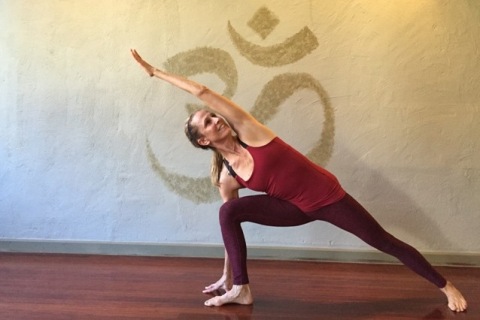
Bound Side Angle Pose

Gate Pose

Revolved Seated Tree

Side Plank
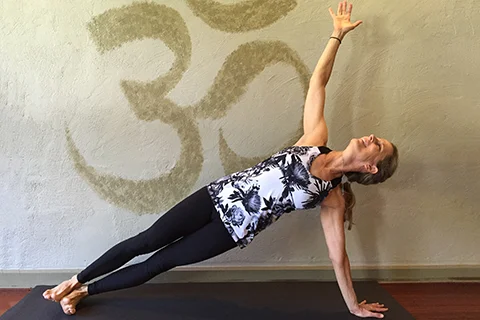
Half Visvamitrasana
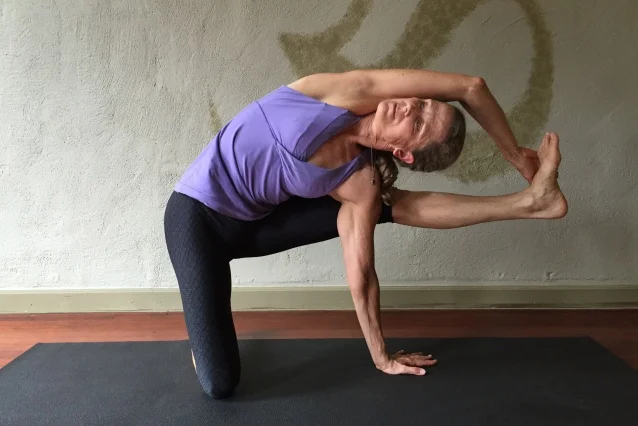
Full Visvamitrasana

