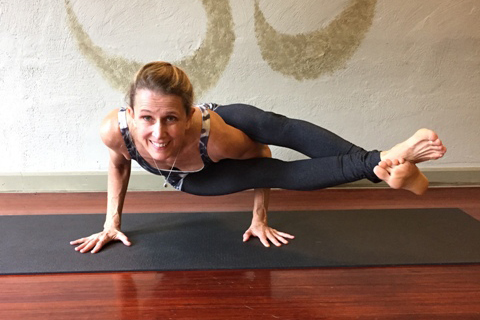
Pose of the Month

Triangle Pose

Utthita Trikonasana

Utthita means extended and Trikonasana means Triangle.  This is Triangle Pose, one of the most basic standing poses and often one of the first poses taught to beginners.  It is the pre-cursor to many other poses including:  Virabhadrasana II (Warrior II), Utthita Parsva Konasana (Side Angle), Ardha Chandrasana (Half Moon),  Virabhadrasana III (Warrior III) and Virabhadrasana I (Warrior I) and Parivrtta Trikonasana (Revolved Triangle)
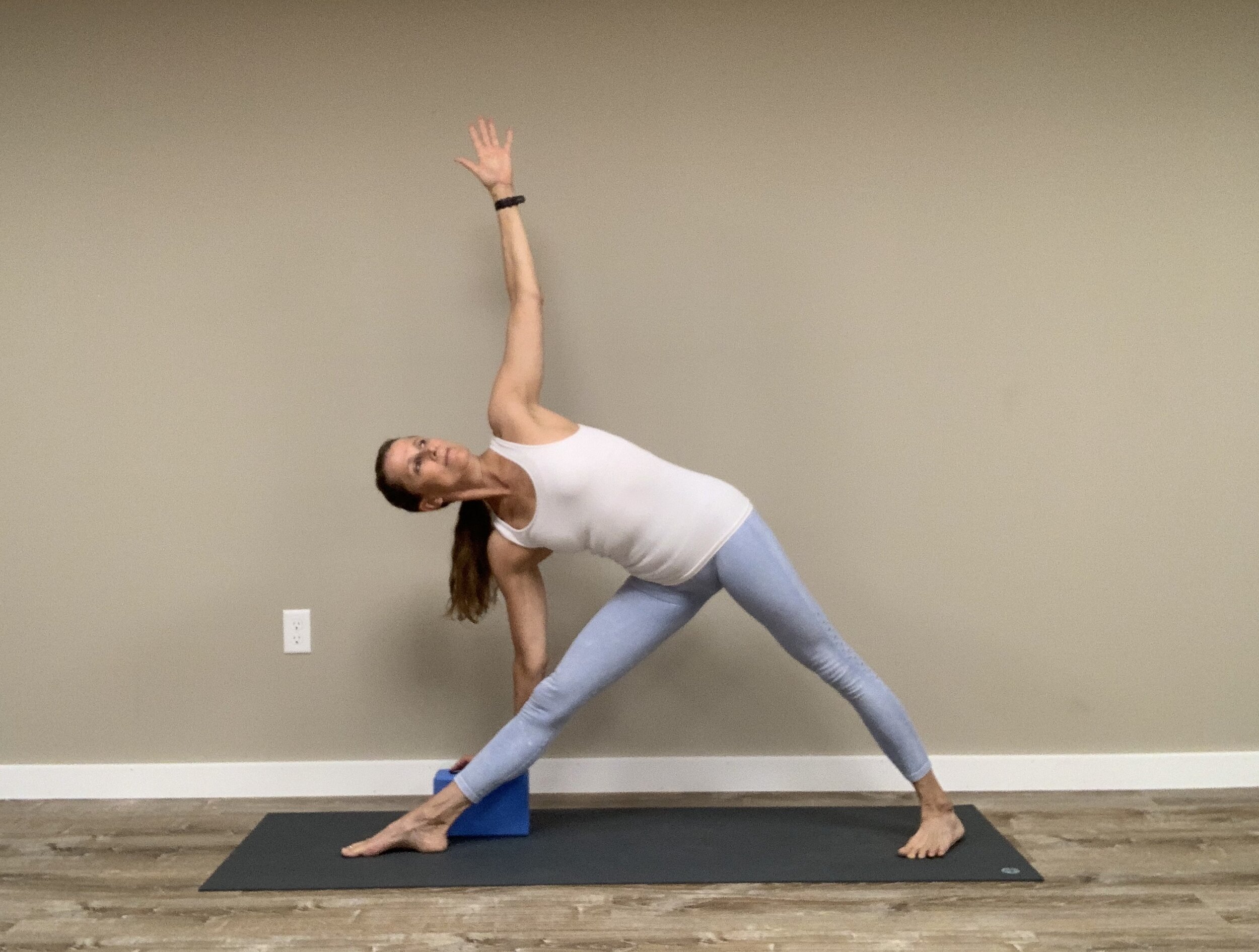

The basic instructions are:

Stand in Tadasana in the middle of your mat facing the long edge.  Bring your hands up to the center of your chest, in line with your collar bones and on an inhalation step or jump your arms and legs 3-1/2 to 4 feet apart. 

Turn your right leg and foot 90 degrees out to the right.  Look to see that the right foot is pointing straight out to the right and that the center of the right heel is in line with the arch of the back foot.  Lift the kneecaps engaging the quads. Keep the arms extended and the chest lifted.  The torso should be centered between the legs.

On an exhalation, reach the right arm out to the right, stretching the right side of your torso out over your right leg, tilting your hips as you go.  Keep the left hip rolling up and back on top of the right hip.  When you can’t go any further, reach the right hand down to touch your shin, or a block, or the floor on the outside of your leg.  Turn your head and look up at your top arm. 

Keep weight on the inner edge of your front foot and the outer edge of your back foot.  Keep the kneecaps lifted as you breathe normally.

On an inhalation, keeping the kneecaps lifted, press down into the inner edge of the front foot and outer edge of the back foot reach out through your left hand and bring yourself up.  Turn your right foot in.  Repeat to the other side.

When finished, step or jump your arms and legs back together and return to Tadasansa. 

This gives you the basic instructions, but it does not tell you exactly where the body is in space.   It is possible to follow these instructions and not end up in a well aligned pose.  For this, you need to be able to look at yourself in the pose.
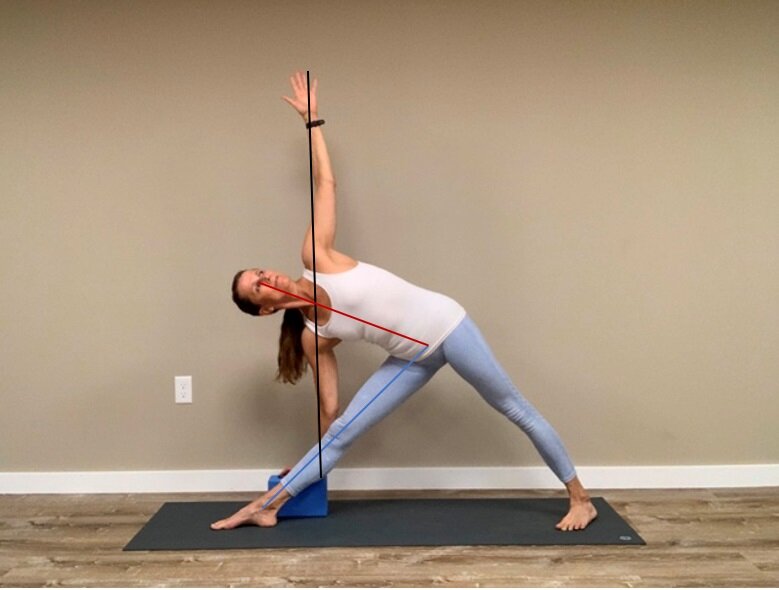
Triangle Pose with alignment points

Triangle Pose with alignment points

Notice how far apart my legs are.  Often the first thing a student needs to learn is to open the legs wide apart.  For this you need the flexibility to spread the legs and the strength to balance in this stance. 

See the relationship of my front arm to my front shin.  My forearm crosses my shin near my knee.  You can’t see this from this angle, but my forearm is also “gating” my front shin; which means that I am pressing my forearm against the shin.  This helps to keep the weight on the inner edge of the front foot. 

Notice that my arms are in a vertical line with my top hand over my shoulder and ultimately in line with my bottom wrist.  There is air and space in my top armpit.  My spine and the sides of my waist are in a straight line and not domed. 

From the head view, you can see that my torso is in line over my front leg, not inside of it or outside of it.  Most students bring the torso to the inside of the front leg in order to get the hand to the floor, mistaking that for the goal of the pose. But all this does is to cause the hips to swing out and the torso to rotate to the floor.

Torso is in line over front leg. See how the wrists and shoulders are in line and they are slightly to the outside of the front leg.  This is correct alignment.

Torso is in line over front leg. See how the wrists and shoulders are in line and they are slightly to the outside of the front leg. This is correct alignment.

Torso is leaning inside of front leg. See how the hands are back and the shoulders are forward. The arms look skewed.  This is incorrect alignment.

Torso is leaning inside of front leg. See how the hands are back and the shoulders are forward. The arms look skewed. This is incorrect alignment.

The other thing to notice from the front view is that I am very two-dimensional.  In other words, my body is still in Tadasana even though it is tipped to the side. My buttocks are not moving backwards, my head is not drifting forward and my torso is in a vertical plane.  This is the goal of the pose, not getting the hand to the floor.

Another subtle thing to notice is that while my torso is over my front leg, my arms are on the outside of the front leg.  In other words, my arms are slightly behind my torso.  This is the same as it would be in Tadasana.  A lot of shoulder problems come from not being able to roll the shoulders back and lift the base of the throat.  Look to see that my arms are vertical in this plane as well.

The gaze should be looking into the top hand, or as close as you can to it.  This is easier if the top hand is not drifting behind you.  Make sure that your head is in line with your spine and centered between your shoulders.  Don’t drop the head backwards to look up at your top hand.  The last thing I want to mention is that the head is turned to be looking up at the top hand.  I like to give the cue to look at your right hand with your right eye and try to see with your left eye what your right eye can see. 

Head in line with the spine.

Head in line with the spine.

Head dropped.  Bottom ear is closer to the bottom shoulder.

Head dropped. Bottom ear is closer to the bottom shoulder.

Take a look at yourself in a mirror as you do Triangle Pose and notice where your body is in space.

What do you Look Like in a Forward Bend?

Forward Bending

You will often hear me give the cue that the back of the head should be in line with the upper back when folding forward so that you are not rounding your back. Do you know what you look like when you are forward bending?    It is important to see yourself when you are folding forward.  Often what you feel you are doing and what actually are doing can be two very different things.  You can see yourself by looking in a mirror the next time you are practicing.  Or, you can enlarge a thumbnail of yourself on the screen in your next zoom class.   

When forward bending it is important to move from the hips.  Unfortunately, if your hamstrings are tight, you might end up bending from the waist, and/or reaching from the shoulders.  These positions are especially important when we hold forward bends for a long time as in the Immune System Sequence

Let’s take a look at what this can look like in Prasarita Padottanasana, or Wide-Legged Forward Bend.

In this first picture, I am hinging from the hips and, being fairly flexible, I can place my head on the floor with my back mostly straight, there is just some slight rounding at the end of the pose.

prasarita padottanasana head supported web large rotated l.jpg

In this next picture, I am trying to be a student with tight hamstrings and I cannot fold forward very well.  You can see that I can hinge at the hips to 90 degrees, but to go any further, I am rounding my back and reaching out of my shoulders to get my hands to the floor.  I am using blocks to support my head, but the back of my head is lower than my upper back. which means that my chest is collapsed and I am reaching out of my shoulders to touch the floor.  My experience in this pose is that I am pretty uncomfortable.

Prasarita Padottanasana head on blocks back rounded web large.jpg

Here is the same posture using a chair instead.  While the chair might be a more appropriate prop for me, how it’s being used is not conducive to folding forward; my back is still rounded with my head lower than my upper back and I am still reaching out of my shoulders.

Prasarita Padottanasana using a chair incorrectly web large.jpg

Check out this last picture.  I am still a student with tight hamstrings, but I am using the chair appropriately.  My back is straight.  I have a straight line from my hips to my elbows.  There is no rounding of my back. The back of my head is in line with my upper back and I am not reaching out of the shoulders.  In this position I am hinging at the hips.  This position looks more like the first picture of myself in the full pose.  It also feels very similar as opposed to the other two which don’t feel as good. 

Prasarita padottanasana using a chair web large.jpg


Practicing a forward bend, or any pose, in proper alignment will take you deeper into the pose over time.  This version of the pose also shows me that the student understands what is meant to be happening in the pose.  In other words, it’s not important to get your hands to the floor.  It is important to hinge at the hips and to keep as much of Tadasana in your posture as possible. 

Revolved Side Angle or Parivrtta Parsva Konasana

Revolved SIde Angle

Parivrtta means revolved, turned round or back.
Parsva means side or flank.
Kona is an angle.

Parivrtta-Parsva-Konasana-full-pose-web-large-640-x-427.jpg

This is revolved side angle pose. It is a deep twisting posture that forms the foundation of many other twisting poses such as Parsva Bakasana, Side Crow and Eka Pada Koundinyasana I, a twisting arm balance.  As we play with this pose this month, we will see where it leads us.

Parivrtta Parsva Konasana looks like Side Angle Pose with a twist, however, it is more related to Warrior I as the hips are facing the front leg, rather than turned open.  It is a harder twist than Revolved Triangle Pose because of the position of the bent knee.  The bent knee locks the hips in and restricts the twisting action in the lower back. In Revolved Triangle Pose, the twist is more evenly spread over the length of the spine. It is for this reason that Revolved Side Angle Pose can be therapeutic for the low back.  But, it is also a caution to allow the spine to twist organically and not to try to force the twist.  We will use other more open twists to prepare the body to come into Revolved Side Angle Pose.

The nature of twisting poses is that they change energy.  If you are feeling stuck and lethargic, twists can help you get unstuck and energize you.  On the other hand if you’re feeling wound up, twists can release energy and calm you down.

The thing about twists, however, is that when we run into difficulty in this pose we literally run into our self. Our own body gets in our way. How do we sit with the energy of that? What does it bring up for us? Does the judge or critic show up? Do we get mad or frustrated with ourselves? Do we try to use our arms for leverage and try to force ourselves into some external, or preconceived idea about ourselves? This is the interesting, inner work of the pose.

Pay attention to your breath while practicing Parivrtta Parsva Konasana.  We generally use an exhalation to come into a twist and an inhalation to come out.  Once you are in the pose notice your breath.  It will be a little more restricted , but can you still breathe easily?

Poses for the Month of December - The Year in Review

2019 Poses in Review

The time between Thanksgiving and New Year’s are so jam packed and busy, I often feel compelled to teach restorative poses just so people can have a few minutes of relaxation.  That doesn’t mean that the entire class will be restorative, it just means that we might start or end with a restorative pose or two.  In the middle, I plan on reviewing the poses that we went over this year.  Here they are in the order in which we did them:

January – Sarvangasana or Shoulder Stand

Read about Shoulder Stand here.

Read about Shoulder Stand here.

February – Sirsasana I or Head Stand on forearms

Read about Head Stand here.

Read about Head Stand here.

March – Navasana or Boat Pose

Read about Boat Pose here.

Read about Boat Pose here.

April – Bakasana or Crow

Read about Crow Pose here.

Read about Crow Pose here.

May – Svarga Dvijasana or Bird of Paradise

Read about Bird of Paradise here.

Read about Bird of Paradise here.

June – Hanumanasana or Split

Read about Split here.

Read about Split here.

July – Parivrtta Parsva Konasana or Revolved Side Angle Pose

Parivrtta-Parsva-Konasana-full-pose-web-large-640-x-427.jpg

Read about Revolved Side Angle Pose here.

August- Visvamitrasana or Side Plank with lower leg lifted

Read about Visvamitrasana here.

Read about Visvamitrasana here.

September – Urdhva Dhanurasana or Wheel

Read about Wheel here.

Read about Wheel here.

October – Prasarita Padottanasana to Sirsasana II or Wide Leg Forward Fold to Tripod Head Stand

Wide-Legged-Forward-Fold-4-x-6.jpg
Sirsasana-II-wide-legs-web-large-4-x-6.jpg
Read about the transition from Wide Legged Forward Fold to Headstand here.

Read about the transition from Wide Legged Forward Fold to Headstand here.

November – Astavakrasana or Eight Crooked Places Pose

Astavakrasana-SC-web-thumb.jpg

Read about Astavakrasana here.

December – I hope you enjoy this year in review!  Also, if you have any requests for poses that you would like to work on next year, let me know in the comments below.